
IMAT 2026 Guide: rules, scoring and preparation
Learn how IMAT 2026 works, official rules, scoring, registration and how to prepare effectively without stress.


When you start thinking seriously about the IMAT, International Medical Admission Test, the questions usually come all at once. How does the test really work, what applies for 2026, how rankings are built, when and how to register, how scoring works, what to study and how to prepare without getting lost in ministerial documents.
In this article we walk through those questions one by one, in a clear and straightforward way. We focus on what is officially required, what is currently known for 2026, and above all what a student actually needs to do, step by step, to prepare in an organised and calm way. Official documents remain the reference point, while practical tools like TestBuddy help turn rules into an actionable study path.
All the information below is based on the most recent official admission call published by the Italian Ministry of University and Research, together with its technical annexes and the national access portal. At the moment, the reference framework is the admission call for the 2025/2026 academic year, which represents the latest officially available regulation.
IMAT 2026 updates
As of today, no official document introducing specific changes for IMAT 2026 has been published. This is an essential point to clarify, because many unofficial sources speculate about changes that are not supported by formal acts.
In the absence of new ministerial measures, IMAT 2026 follows the same rules as the latest officially regulated edition, namely 2025/2026. Any future change can only come through a newly published ministerial decree or official notice.
This means that students preparing now can rely on a stable and well defined structure, without chasing assumptions. Having a tool like TestBuddy helps exactly here: preparation is built on solid rules, while staying ready to adapt if and when official updates are released.
Scoring system, ranking and results
The IMAT consists of 60 multiple choice questions. Each correct answer is worth 1.5 points, each incorrect answer results in a 0.4 point penalty, and unanswered questions score 0 points. The maximum achievable score is 90.
Scores are used to build the national ranking for candidates from the European Union and equivalent categories. A separate ranking applies to non European Union candidates residing abroad and is managed directly by universities.
One critical detail is that candidates who do not answer any question are excluded from the ranking. In case of tied scores, specific criteria established by the official regulation are applied, including performance in individual subject areas.
Results are released in several stages. First, anonymous scores are published. Then candidates can view their personal results in the reserved area. Finally, the national ranking is released. This process usually unfolds over several weeks.
Using TestBuddy helps reduce uncertainty in this phase, because realistic simulations and performance statistics allow students to understand their level well before official results are published, making the final outcome easier to interpret.
Test fees and university costs
The registration fee for the IMAT is not directly stated in the main regulatory text, but is communicated during the official registration phase through the institutional portal. Payment is mandatory to complete the application.
University tuition fees are a separate matter. They are not defined at national level and depend entirely on the university where the student is admitted, as well as personal and financial conditions.
For this reason, preparation should focus first on passing the test. Financial details related to enrolment are evaluated only after seat assignment, following each university’s official regulations.
Official simulations and practice material
From an institutional perspective, the only official practice materials are the IMAT exams published in previous years by the Ministry through the national access portal. There is no official pre published question bank specifically dedicated to IMAT.
This means preparation should rely on past official exams and the official syllabus. Training without exposure to real exam style questions is one of the most common mistakes.
This is where TestBuddy naturally fits in. Structured simulations aligned with official scoring rules help students practice under realistic conditions, without introducing artificial difficulty or irrelevant question formats.
IMAT registration process
Registration for the IMAT is carried out exclusively online through the Universitaly portal, within a specific time window. For the most recent official edition, registration opened on 26 August 2025 and closed on 9 September 2025 at 15:00.
During registration, candidates must indicate their preferred universities and courses, in strict order of preference. These choices become final once the registration period closes. If the test is taken in Italy, the first preference automatically corresponds to the exam venue. If taken abroad, the exam venue must be selected from the official list.
Once registration closes, preferences cannot be modified. This makes it essential to reach this stage with clear decisions and an objective understanding of one’s preparation level. Tools like TestBuddy support this phase by showing how competitive a candidate currently is before preferences are locked in.
Test structure and official syllabus
The IMAT lasts 100 minutes and includes 60 questions divided into defined sections. These cover reading comprehension and logical reasoning, followed by scientific subjects: biology, chemistry, physics and mathematics.
The official syllabus precisely lists all examinable topics. It is not a generic outline but a technical document that should be studied carefully.
Effective preparation does not treat all topics equally. Understanding topic weight, recurrence and time allocation is essential. TestBuddy is designed to convert the official syllabus into targeted practice, topic level statistics and adaptive study plans based on real performance data.
Extra time and compensatory measures
The official regulation allows candidates with disabilities or Specific Learning Disorders to request extra time and compensatory measures.
Candidates with certified disabilities may receive up to 50% additional time, while candidates with Specific Learning Disorders may receive up to 30% additional time. Proper documentation must be submitted within the deadlines set during the registration phase and according to the requirements of the exam venue.
Foreign certifications must be valid and accompanied by compliant translations when required. These requests must be handled early, as late submissions may not be accepted.
Non EU candidates, special cases and minors
Non European Union candidates residing abroad follow a distinct procedure, with a reserved ranking managed directly by universities. Pre enrolment for visa purposes must be completed through the Universitaly portal, according to deadlines defined each year.
For underage candidates, official IMAT documents do not specify additional procedures for taking the test itself. Any further administrative requirements usually apply at the enrolment stage and depend on individual university regulations.
Preparing for the IMAT
Preparing for the IMAT means following the official syllabus and practising with materials that reflect the real exam structure. Accumulating unnecessary resources or unofficial strategies is not helpful.
Effective preparation is based on simulations, error analysis and continuous improvement. This is where TestBuddy becomes a concrete support: realistic simulations, artificial intelligence to identify weaknesses, clear statistics to track progress and a structured path that helps reduce anxiety by making preparation measurable and transparent.
Studying while knowing where you stand and what to improve fundamentally changes the way a selective exam like the IMAT is approached.
Official reference sources
All information in this article is derived exclusively from institutional documents:
admission call
official technical annexes
official syllabus
national access portal
🎯 Simulatore IMAT (Medicina inglese)
Scopri a che punto sei davvero
Simulazioni cronometrate come il test reale, domande aggiornate e correzioni commentate: in 20 minuti sai quanto sei pronto.
Simulazione IMAT (Medicina inglese) gratisGratis · 100.000+ studenti · 4,3 su 5, oltre 850 valutazioni su App Store e Google Play
Ti è stata utile questa guida?
Aiutaci a migliorare lasciando una valutazione
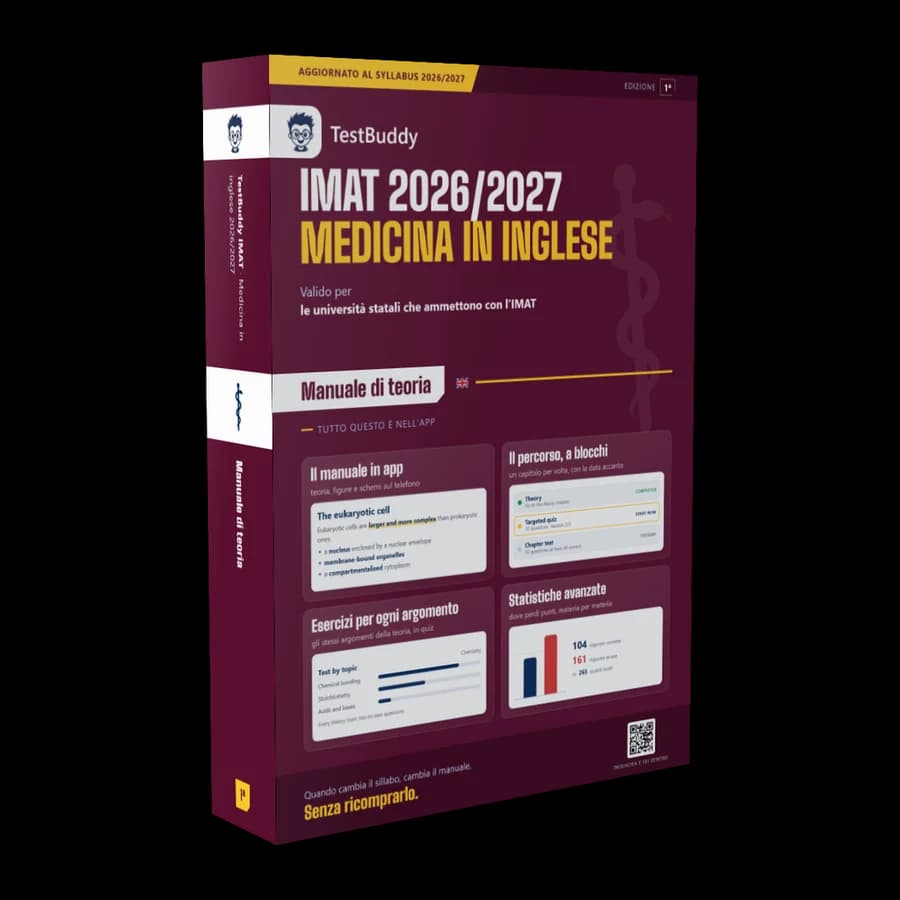
📘 Il manuale TestBuddy
Il manuale di teoria per IMAT (Medicina inglese)
Tutta la teoria, capitolo per capitolo, già dentro l'app: la studi da telefono e da computer, ed è inclusa nell'abbonamento.
- Tutte le materie del programma, spiegate in modo chiaro
- Quiz collegati a ogni capitolo, per mettere subito in pratica
- Si aggiorna quando cambia il programma, senza ricomprare niente
Guide utili per iniziare
Tutto quello che ti serve sapere per prepararti al meglio


Scritto e verificato da
Redazione TestBuddy
Un team di docenti, tutor e professionisti specializzati nella preparazione ai test di ammissione universitari e concorsi pubblici. Ogni guida viene redatta, revisionata e aggiornata per offrirti informazioni accurate e affidabili.