
IMAT 2026 Registration: How to Apply, Deadlines and Procedure
Learn how to register for IMAT 2026 through Universitaly, the steps to follow, and how to navigate pre-enrolment, deadlines, and the registration process.


IMAT 2026 Registration: how to apply, deadlines and procedure
IMAT 2026 registration is one of the most important steps for students who want to enter Medicine and Surgery in English in Italy.
In this guide, we explain how registration works, where to apply, when registrations are expected to open, how pre-enrolment on Universitaly works, which mistakes to avoid and what happens after the result, when admission must become actual enrolment.
For 2026, some specific information has not been published yet. Where official updated data is missing, we use the most recent available reference, which is the 2025 procedure.
IMAT 2026 registration: what we know today
At the moment, the specific IMAT 2026 call has not been published yet, so the following details are not official yet:
- registration opening date;
- registration closing date;
- exam date;
- registration fee;
- final list of test centres;
- 2026 ranking calendar.
For now, the procedure to use as reference is the latest available edition.
StepOfficial 2025 datesRegistration opens26 August 2025Registration closes9 September 2025, 15:00Test date17 September 2025Score by label code published25 September 2025Test paper and personal data sheet on Universitaly6 October 2025National named ranking list13 October 2025First ranking scroll20 October 2025
As soon as the IMAT 2026 calendar is released, the most important things to check will be the registration window, the closing time and the ranking deadlines, because these steps are strict.
Where to register for IMAT 2026
IMAT registration is completed online on Universitaly.
You do not register through the website of a single university during the first stage.
The centralised procedure is used to:
- register for the test;
- enter personal data;
- choose preferences;
- pay the participation fee;
- check results and ranking status;
- confirm interest during ranking scrolls.
Universities become involved mainly later, when the candidate is assigned or decides to enrol while booked.
How to register for IMAT
The procedure follows these steps:
- create or access your Universitaly account;
- enter the area dedicated to IMAT;
- fill in the required personal data;
- enter identity document details;
- select course and university preferences;
- complete the payment;
- download and keep the registration receipt.
The application is valid only if the procedure is completed correctly.
Creating an account is not enough.
Filling in the application without paying is not enough.
Paying without correctly completing the online registration does not give the right to sit the test.
Required data and documents
During registration, personal and identification data are required.
Usually, students need:
- name and surname;
- date and place of birth;
- citizenship;
- tax code, if available;
- email address;
- residence;
- phone number, if requested;
- document type;
- document number;
- issuing authority;
- document expiry date;
- any language certificate, if held.
The data entered must be correct, because it has the value of a personal declaration.
The email address is especially important: official communications arrive there.
How to choose test centre and preferences
For IMAT, students cannot freely choose the exam date.
The test takes place on a single national date.
The most delicate part is choosing preferences.
Candidates must list the universities and courses they want to compete for in order of priority.
For candidates taking the test in Italy, the first preference also determines the test centre.
For candidates taking the test abroad, one foreign test centre must be selected from the available options.
After the registration deadline, preferences become final.
This means the chosen order can directly affect the candidate’s path in the ranking.
IMAT pre-enrolment 2026 on Universitaly
Pre-enrolment mainly concerns international students who need to apply for a visa.
It is not the same thing as IMAT registration.
The distinction is important:
- IMAT registration: required to take the test;
- Universitaly pre-enrolment: required for international students for visa and university access procedures.
For the 2026/2027 academic year, the procedure for international students is already available.
The visa application must be submitted by 30 November 2026.
Pre-enrolment validated by the university does not automatically guarantee the visa.
The visa does not automatically guarantee enrolment.
Final enrolment always depends on the university’s rules and on the candidate’s position.
IMAT 2026 registration fee
The IMAT 2026 fee has not been published yet.
Usually, the amount is shown during the registration procedure on Universitaly.
Payment must be completed by following the portal instructions.
At national level, the most recent documents do not show general exemptions valid for everyone, unless specific instructions are published for the relevant year.
The practical rule is simple:
- without completed payment, registration is not valid;
- without the online registration receipt, payment alone is not enough.
Common mistakes to avoid
The most common mistakes concern the procedure, not studying.
The most important ones to avoid are:
- creating only a Universitaly account and thinking you are registered;
- filling in the application but not completing payment;
- paying without downloading or keeping the receipt;
- entering incorrect personal data;
- using an invalid or expiring document;
- using an email address you do not check;
- choosing preferences superficially;
- waiting until the last day to register;
- not checking your reserved area after the test.
The most serious mistake is missing a deadline.
In the IMAT system, deadlines are strict and being late can make you lose the right to take the test or enrol.
🎯 Simulatore IMAT (Medicina inglese)
Scopri a che punto sei davvero
Simulazioni cronometrate come il test reale, domande aggiornate e correzioni commentate: in 20 minuti sai quanto sei pronto.
Simulazione IMAT (Medicina inglese) gratisGratis · 100.000+ studenti · 4.4★ su App Store e Google Play
Can registration be modified or cancelled?
For 2026, an updated official procedure is not available yet.
In the latest edition, before the registration deadline, the last confirmation submitted by the candidate was considered valid.
After the deadline, preferences became:
- final;
- irrevocable;
- impossible to add to.
The most recent documents do not show a general national procedure to cancel registration or obtain a refund after closing.
What happens after the test
After IMAT, results follow a national procedure.
The candidate may have one of these statuses:
- assigned;
- booked;
- waiting.
An assigned candidate must enrol at the indicated university within the required deadline.
A booked candidate can:
- enrol immediately at the university where they are booked;
- wait for later ranking scrolls to try to obtain a higher preference.
If a booked candidate enrols, they automatically give up all other options.
Enrolment after admission
Enrolment is not completed on Universitaly.
After admission, the candidate must follow the procedure of the single university.
Usually, the university requires:
- access to the university student portal;
- enrolment confirmation;
- upload of required documents;
- payment of the first instalment;
- any economic documentation;
- any documentation for foreign qualifications.
Enrolment deadlines are essential.
In the latest available procedure, assigned candidates had 4 days to enrol, excluding Saturdays and public holidays.
Failure to respect the deadline meant losing the place.
Confirmation of interest during ranking scrolls
Students who do not enrol immediately must pay attention to the confirmation of interest.
In the latest available procedure, candidates who were not enrolled and had not withdrawn had to confirm their interest in remaining in the ranking within the required deadline.
Failure to submit the confirmation led to exclusion from later ranking scrolls.
This is one of the most dangerous mistakes, because it can make students lose their place even after correctly taking the test.
Documents for students with foreign qualifications
Students with foreign qualifications must follow the requests of the university.
In general, they may be asked for:
- final secondary school qualification;
- documentation proving at least 12 years of schooling;
- translation of documents, if required;
- legalisation or apostille, if required;
- declaration of value or equivalent documents;
- comparability or verification statements;
- language certificate, if required;
- visa and residence documents.
For courses taught in English, proof of language knowledge may be required, usually at least B2 level of the Common European Framework of Reference for Languages, where applicable.
Costs after admission
After admission, there is no single national tuition fee equal for everyone.
Each university defines:
- first instalment;
- university contributions;
- payment deadlines;
- possible reductions;
- required economic documents.
Reductions may depend on the Equivalent Economic Situation Indicator or equivalent documentation for international students.
Scholarships and benefits are managed by universities, regional bodies and dedicated procedures.
This is why, after being admitted, students must immediately check the website of the university where they will enrol.
Preparing while managing registration
Registration is a decisive step, but it does not replace preparation.
The score remains the factor that truly determines the chance of admission.
This is why it is useful to study with a trackable method: realistic simulations, topic-based exercises, digital manual, statistics and progress control.
On TestBuddy, students can start for free and prepare for IMAT with an organised path, monitoring their level with the TB Score and reducing test anxiety.
IMAT 2026 registration checklist
Before registration opens:
- check the publication of the IMAT 2026 calendar;
- verify that you have a valid document;
- create or recover your Universitaly account;
- prepare your personal data;
- clarify the order of your preferences;
- check whether pre-enrolment is required for a visa.
During registration:
- enter the IMAT area on Universitaly;
- fill in all required data;
- enter the document correctly;
- choose universities and courses in order of priority;
- complete the payment;
- download the receipt;
- check the email address entered.
After the test:
- check score and reserved area;
- verify ranking status;
- enrol within the deadline if assigned;
- decide whether to enrol or wait if booked;
- confirm interest when required;
- follow the university instructions;
- pay the first instalment by the deadline.
Final recap and official links
For IMAT 2026, the specific calendar, fee, registration dates and ranking dates are not available yet. The latest official procedure provided registration from 26 August 2025 to 9 September 2025 at 15:00, test date on 17 September 2025 and national ranking list on 13 October 2025.
Registration takes place through Universitaly, while ministerial rules and updates are published in the official programmed access area. For international students, 2026/2027 pre-enrolment follows the dedicated procedure for foreign students and the visa application must be submitted by 30 November 2026.
The information comes from Universitaly, the official Ministry of University and Research programmed access area, the official IMAT 2025 ministerial decree, the 2026/2027 procedures for international students and the ministerial page on the right to study.
🎯 Simulatore IMAT (Medicina inglese)
Scopri a che punto sei davvero
Simulazioni cronometrate come il test reale, domande aggiornate e correzioni commentate: in 20 minuti sai quanto sei pronto.
Simulazione IMAT (Medicina inglese) gratisGratis · 100.000+ studenti · 4.4★ su App Store e Google Play
Ti è stata utile questa guida?
Aiutaci a migliorare lasciando una valutazione
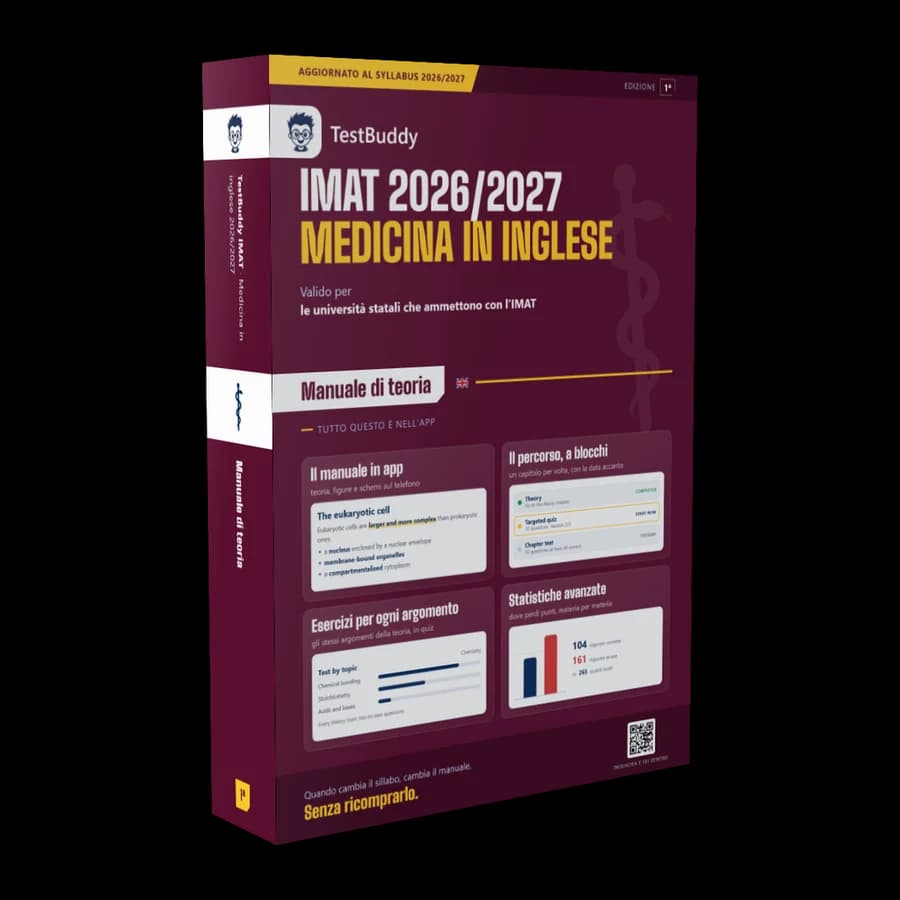
📘 Il manuale TestBuddy
Il manuale di teoria per IMAT (Medicina inglese)
Tutta la teoria, capitolo per capitolo, già dentro l'app: la studi da telefono e da computer, ed è inclusa nell'abbonamento.
- Tutte le materie del programma, spiegate in modo chiaro
- Quiz collegati a ogni capitolo, per mettere subito in pratica
- Si aggiorna quando cambia il programma, senza ricomprare niente
Guide utili per iniziare
Tutto quello che ti serve sapere per prepararti al meglio


Scritto e verificato da
Redazione TestBuddy
Un team di docenti, tutor e professionisti specializzati nella preparazione ai test di ammissione universitari e concorsi pubblici. Ogni guida viene redatta, revisionata e aggiornata per offrirti informazioni accurate e affidabili.