
What to bring on IMAT test day without mistakes
Learn what to bring and what is forbidden on IMAT test day. Documents, exam rules, and common mistakes explained clearly.


When the IMAT test day gets closer, one of the most important questions is not about biology or logical reasoning, but something much more practical: what you must bring with you and what is strictly forbidden.
This is completely normal. The rules are formal, strict, and often unclear for students taking the test for the first time.
In this guide we focus only on what really matters. We explain which documents are required, which items are allowed, what must never enter the exam room, how to organize your bag, what happens when you arrive at the venue, which mistakes can cost you the test, and how to arrive in the right condition.
Everything is based on the official rules governing the exam, rewritten in a clear and accessible way so you can walk into the test without unnecessary doubts.
Mandatory documents to bring to the exam venue
The first essential element on test day is personal identification.
Every candidate must bring a valid identity document, the same one used during the registration process. The data must match exactly, because identification in the exam room is carried out by comparing the document with the registered personal details.
Without a valid identity document, you are not allowed to take the test, regardless of your level of preparation.
According to the official procedures, candidates may also be required to show proof of registration. This means having the registration receipt with you, either in paper or digital format, depending on what is specified by the exam venue.
All declarations made during registration have legal value. It is essential that the information provided is accurate, because incorrect declarations can lead to exclusion, even after the test has been taken.
Allowed items during the test
Inside the exam room, only explicitly permitted items are allowed.
During the test, candidates may use exclusively the black pen provided by the exam venue. Personal pens, pencils, or other writing tools are not allowed.
All official materials, including the question booklet, answer sheet, and instruction sheet, are distributed directly in the exam room.
It is not allowed to bring blank sheets or any additional paper.
This rule is critical: even possessing prohibited items without using them can result in annulment, if they are discovered during checks.
Prohibited items: what must never enter the exam room
The rules regarding prohibited items are among the strictest.
It is forbidden to bring or use any electronic device, including mobile phones, smartphones, smartwatches, tablets, earphones, or similar equipment.
Books, manuals, notes, loose sheets, printed or handwritten materials of any kind are strictly prohibited, even if they are not consulted.
Personal writing tools are also forbidden. Everything that is not supplied by the exam commission must remain outside the exam room, following the procedures indicated by the venue.
The use or possession of prohibited items results in immediate exclusion from the test.
How to organize your bag for test day
Your bag should be prepared in a minimal and essential way.
Inside it, you should only have what is strictly necessary: a valid identity document and, if required by the venue, the registration receipt.
All other items must be left outside the exam room or stored according to the instructions given by the staff.
Arriving with a light, well-organized bag reduces the risk of mistakes and makes entry procedures smoother and less stressful.
Preparation for the IMAT is not only about studying. Logistics matter too. Having everything under control helps you focus only on the test itself. This is the same principle behind TestBuddy: clarity and control reduce anxiety, both during preparation and on exam day.
🎯 Simulatore IMAT (Medicina inglese)
Scopri a che punto sei davvero
Simulazioni cronometrate come il test reale, domande aggiornate e correzioni commentate: in 20 minuti sai quanto sei pronto.
Simulazione IMAT (Medicina inglese) gratisGratis · 100.000+ studenti · 4.4★ su App Store e Google Play
Arrival at the venue and entry procedures
In Italian venues, the IMAT test officially starts at 11:00.
However, candidates are required to arrive earlier, because several mandatory procedures take place before the test begins.
These include identity checks, document verification, and inspection of allowed materials.
After that, exam packages are opened following formal, recorded procedures.
Arriving well in advance is essential. Being late can mean not being admitted to the exam room, depending on the venue’s rules.
What happens if you arrive late
The official regulations establish the test start time, but the management of late arrivals is handled by individual universities.
Since there is no single rule valid everywhere, the real risk is exclusion, even for a short delay.
For this reason, it is crucial to plan your arrival carefully, allowing extra time for transportation, traffic, and entry checks.
Mistakes to absolutely avoid on test day
Many candidates fail not because of poor preparation, but due to formal mistakes.
Serious errors include using prohibited items, interacting with other candidates, entering the wrong exam room, or adding identifying marks to the answer sheet.
Even incorrect completion of the answer sheet can compromise the result. The rules for filling in answers, correcting mistakes, and leaving a question unanswered are precise and must be followed exactly.
Practicing with realistic simulations helps here as well. Getting used to the test format and rules significantly reduces the risk of costly errors. This is one of the reasons why tools like TestBuddy are effective: you train for the real exam conditions, not just the questions.
What to do the day before the test
The day before the test does not involve any in-person procedures, but it is the right moment for final checks.
You should confirm the venue, exam room, schedule, required documents, and make sure you are not bringing any prohibited items.
Official regulations do not provide instructions on diet or personal routines, but arriving with a clear mind and no logistical surprises makes a real difference.
Students with disabilities and Specific Learning Disorders
Candidates with disabilities or Specific Learning Disorders may receive compensatory measures and additional time, provided these were correctly requested during registration.
Additional time can be up to 50% for disabilities and up to 30% for Specific Learning Disorders, with possible further adjustments in specific cases.
All certifications must meet the requirements set by the official procedures and be submitted according to the established rules.
Technical issues or unexpected problems during the test
If any issue arises during the test, such as a damaged exam package or a material error, it must be reported immediately to the exam staff.
All irregularities are handled and officially recorded by the exam commission.
For issues related to registration or the online system, official institutional support channels are available through the relevant portals.
Sources
The information in this guide is based on official documents regulating the IMAT test, published on institutional platforms. The main references are the Universitaly portal, the Italian Ministry of University and Research website, and the official documentation related to the admission procedure.
🎯 Simulatore IMAT (Medicina inglese)
Scopri a che punto sei davvero
Simulazioni cronometrate come il test reale, domande aggiornate e correzioni commentate: in 20 minuti sai quanto sei pronto.
Simulazione IMAT (Medicina inglese) gratisGratis · 100.000+ studenti · 4.4★ su App Store e Google Play
Ti è stata utile questa guida?
Aiutaci a migliorare lasciando una valutazione
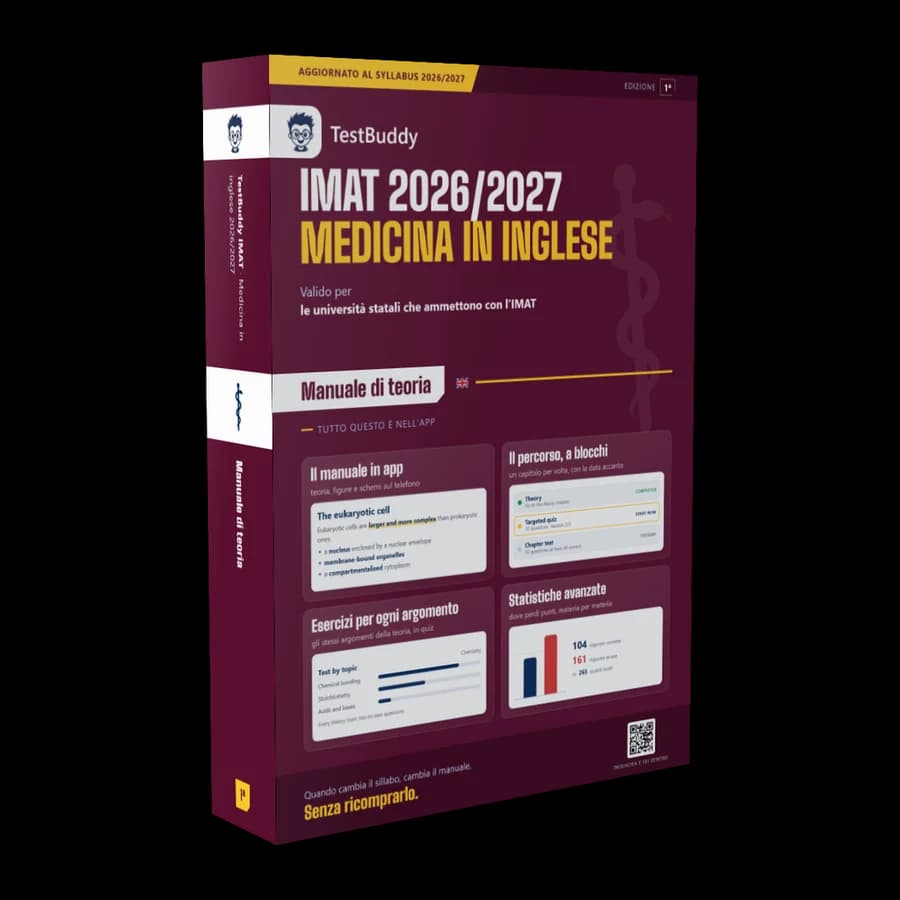
📘 Il manuale TestBuddy
Il manuale di teoria per IMAT (Medicina inglese)
Tutta la teoria, capitolo per capitolo, già dentro l'app: la studi da telefono e da computer, ed è inclusa nell'abbonamento.
- Tutte le materie del programma, spiegate in modo chiaro
- Quiz collegati a ogni capitolo, per mettere subito in pratica
- Si aggiorna quando cambia il programma, senza ricomprare niente
Guide utili per iniziare
Tutto quello che ti serve sapere per prepararti al meglio


Scritto e verificato da
Redazione TestBuddy
Un team di docenti, tutor e professionisti specializzati nella preparazione ai test di ammissione universitari e concorsi pubblici. Ogni guida viene redatta, revisionata e aggiornata per offrirti informazioni accurate e affidabili.