
Healthcare Professions Admission Test in English 2026
Complete guide to the Healthcare Professions admission test in English 2026: structure, subjects, scoring, and what to study effectively.


The 2026 admission test for Healthcare Professions taught in English now has an official structure for the 2026/2027 academic year. In this guide, we explain how many questions there are, how long the test lasts, which subjects you need to study, which topics are included in the syllabus, and how to organize your preparation depending on how much time you have left.
The most important thing is to start from the actual structure of the test: Biology and Chemistry together account for 38 out of 60 questions, so they should take up a major part of your study plan, without neglecting Physics, Mathematics, Logical Reasoning, and Reading Comprehension.
What is the test called?
There is no specific official acronym for this exam.
In the official documents, it is referred to as the admission test for Healthcare Professions degree courses taught in English.
For 2026, the national test date for Healthcare Professions in English is 17 September 2026.
Structure of the 2026 Healthcare Professions test in English
The test consists of 60 multiple-choice questions.
Each question has 5 answer options, with only 1 correct answer.
You have 100 minutes to complete the test.
| Subject | Questions |
|---|---|
| Biology | 23 |
| Chemistry | 15 |
| Physics and Mathematics | 13 |
| Logical Reasoning and Problem Solving | 5 |
| Reading Comprehension and Knowledge Acquired During Previous Studies | 4 |
| Total | 60 |
This distribution is unchanged from 2025.
Biology and Chemistry alone account for 38 out of 60 questions, which is more than 63% of the entire test. This is the main factor to keep in mind when deciding how much time to dedicate to each subject.
How the test works at different universities
The ministerial framework defines the general structure, content, and assessment criteria, while the practical organization of the test is handled by individual universities.
A useful example is the University of Palermo.
For the 2026/2027 Nursing programme taught in English, the admission notice published on 10 August 2026 states that the test:
- takes place on 17 September 2026;
- is prepared by the University of Palermo within the ministerial framework;
- includes 60 questions;
- lasts 100 minutes;
- requires English proficiency equivalent to B2 level under the Common European Framework of Reference for Languages.
The ministerial structure therefore remains the general reference, but students should always check the admission notice published by their chosen university for practical procedures, check-in times, and specific requirements.
What you actually need to study
The official syllabus lists the topics required for each subject.
There is no need to add arbitrary chapters or rely on unofficial programmes: the starting point should always be the ministerial syllabus.
Biology
Biology is the most heavily weighted subject, with 23 questions.
The syllabus includes:
- chemistry of living organisms;
- organic molecules and their functions;
- enzymes;
- cell theory;
- prokaryotic and eukaryotic cells;
- animal and plant cells;
- viruses;
- cell membranes;
- transport across membranes;
- cellular structures and their functions;
- cell cycle;
- mitosis and meiosis;
- chromosomes;
- sexual and asexual reproduction;
- Mendelian genetics;
- chromosome theory of inheritance;
- molecular genetics;
- structure and replication of deoxyribonucleic acid;
- genetic code;
- protein synthesis;
- regulation of gene expression;
- human genetics;
- hereditary diseases;
- mutations;
- natural and artificial selection;
- evolution;
- relationship between heredity and environment;
- biotechnology;
- recombinant deoxyribonucleic acid technology;
- animal tissues;
- human anatomy and physiology;
- body systems;
- homeostasis;
- bioenergetics;
- adenosine triphosphate;
- photosynthesis;
- glycolysis;
- aerobic respiration;
- fermentation.
Because of both the size of the syllabus and the number of questions, Biology should take up a significant part of your preparation from the beginning.
Chemistry
Chemistry includes 15 questions and is the second most important subject in the test.
The official syllabus covers:
- structure of matter;
- states of matter;
- homogeneous and heterogeneous systems;
- elements and compounds;
- ideal gases;
- atomic structure;
- atomic number and mass number;
- isotopes;
- electron configuration;
- periodic table;
- periodic properties;
- ionic bonds;
- covalent bonds;
- metallic bonds;
- electronegativity;
- polarity;
- intermolecular forces;
- oxides;
- hydroxides;
- acids;
- salts;
- atomic and molecular mass;
- Avogadro’s number;
- mole concept;
- stoichiometry;
- balancing chemical reactions;
- solutions;
- concentration;
- equilibria in aqueous solutions;
- chemical kinetics;
- catalysis;
- oxidation and reduction;
- oxidation numbers;
- acids and bases;
- hydrogen potential;
- hydrolysis;
- buffer solutions;
- organic chemistry;
- isomerism;
- hydrocarbons;
- alcohols;
- ethers;
- amines;
- aldehydes;
- ketones;
- carboxylic acids;
- esters;
- amides.
Preparation should therefore not stop at general chemistry: stoichiometry, acids and bases, and organic chemistry are also part of the official programme.
Physics
Physics is included in the 13 combined Physics and Mathematics questions.
The syllabus includes:
- physical quantities and units of measurement;
- scalar and vector quantities;
- kinematics;
- speed and acceleration;
- linear motion;
- circular motion;
- harmonic motion;
- dynamics;
- laws of motion;
- forces;
- friction;
- impulse and momentum;
- work;
- energy;
- power;
- fluid mechanics;
- pressure;
- Pascal’s, Stevin’s, and Archimedes’ principles;
- continuity equation;
- Bernoulli equation;
- viscosity;
- temperature and heat;
- calorimetry;
- ideal gases;
- thermodynamics;
- electric charge;
- electric field and electric potential;
- capacitors;
- electric current;
- resistance;
- Ohm’s law;
- Kirchhoff’s laws;
- Joule effect;
- magnetic field;
- electromagnetic induction.
🎯 Simulatore Test Professioni Sanitarie (EN)
Scopri a che punto sei davvero
Simulazioni cronometrate come il test reale, domande aggiornate e correzioni commentate: in 20 minuti sai quanto sei pronto.
Simulazione Test Professioni Sanitarie (EN) gratisGratis · 100.000+ studenti · 4.4★ su App Store e Google Play
Mathematics
The Mathematics syllabus includes:
- natural, integer, rational, and real numbers;
- proportions;
- percentages;
- powers;
- roots;
- logarithms;
- combinatorics;
- algebraic expressions;
- polynomials;
- notable products;
- factorization;
- algebraic fractions;
- equations;
- inequalities;
- systems of equations;
- functions;
- domain and codomain;
- graphical representation;
- exponential functions;
- logarithmic functions;
- trigonometric functions;
- plane geometry;
- analytic geometry;
- trigonometry;
- Pythagorean and Euclidean theorems;
- probability;
- basic statistics.
Logical Reasoning and Problem Solving
The test includes 5 questions in this area.
The aim is to assess your ability to complete a line of reasoning correctly based on the information provided.
Problems may be:
- verbal;
- symbolic;
- numerical;
- abstract.
There is no long theoretical syllabus comparable to Biology or Chemistry.
The main focus here should be on practice, because the goal is to learn how to recognize the type of reasoning required as quickly as possible.
Reading Comprehension and Knowledge Acquired During Previous Studies
This section includes 4 questions.
It mainly assesses:
- reading comprehension;
- vocabulary;
- ability to extract information;
- ability to make inferences;
- textual cohesion and coherence;
- historical knowledge;
- geographical knowledge;
- national and international institutions;
- basic social, economic, legal, and civic knowledge.
Texts may come from scientific essays, literature, and current affairs.
An important note about the language of the test
For Healthcare Professions taught in English, the test scheduled for 17 September 2026 is intended to be in English.
The 2026 University of Palermo admission notice states this explicitly.
However, the ministerial annex still contains wording referring to Italian in the section on reading comprehension. As of 11 August 2026, no specific clarification on this wording had been published.
For the actual language used in your test, you should therefore also check the admission notice published by your university.
How scoring works
The maximum score is 90 points.
For each question:
- correct answer: +1.5 points;
- incorrect answer: -0.4 points;
- unanswered question: 0 points.
The penalty means that students need to learn the difference between making an informed choice and guessing completely at random.
Practice tests should therefore always use the same scoring system as the real exam, otherwise the score you obtain during preparation does not accurately reflect your actual level.
How to prepare for the test
The Ministry defines what you need to know, but it does not provide a mandatory study method.
The general expectation is that the required knowledge corresponds to the preparation developed during secondary school.
A practical way to organize your preparation is:
- check every topic in the official syllabus;
- take an initial mock test;
- identify your weakest subjects;
- study the missing theory;
- practise questions by topic;
- regularly take full mock tests;
- track whether your score and error rate improve.
This is also consistent with the approach used in university orientation activities: measure your initial level, identify your gaps, and organize the next stage of your study around them.
Where to start if you are beginning from zero
If you are starting from zero, there is no official ministerial order telling you which subject to study first.
What you should avoid is opening a textbook and moving through it without a clear map.
The first step is to review the entire syllabus and divide topics into:
- never studied;
- studied before but needing revision;
- already reasonably strong.
Then you should take the actual weight of each subject into account:
- Biology: 23 questions;
- Chemistry: 15 questions;
- Physics and Mathematics: 13 questions;
- Logical Reasoning: 5 questions;
- Reading Comprehension and Acquired Knowledge: 4 questions.
This prevents you from spending the same amount of time on sections that have very different weights in the real test.
With TestBuddy, you can start for free and manage theory, topic-based exercises, full simulations, and performance statistics in one place. The TB™ Score also shows what score you would currently achieve on the real test, so your planning is based on measurable progress rather than just the feeling of being prepared.
How to study if you have 6 months
With 6 months available, you can spread the work progressively.
First phase
- complete the main theory for Biology and Chemistry;
- build your foundations in Physics and Mathematics;
- start simple practice questions after each topic.
Second phase
- continue covering the syllabus;
- increase the number of practice questions;
- introduce Logical Reasoning and Reading Comprehension;
- revisit topics where your performance is weakest.
Final phase
- gradually reduce new theory;
- increase full mock tests and mixed-question practice;
- review recurring mistakes;
- focus mainly on the gaps that are still affecting your score.
With several months available, one mistake to avoid is leaving full simulations until the very end.
How to study if you have 3 months
With 3 months, preparation needs to be more selective.
Your priorities should be:
- cover the essential Biology syllabus quickly;
- cover Chemistry;
- study Physics and Mathematics alongside them;
- introduce practice questions from the first weeks;
- take mock tests regularly;
- use the results to decide what needs revision.
At this stage, theory and practice should progress together.
How to study if you have 1 month
With 1 month, you should not divide your time equally across every subject.
Focus on:
- syllabus topics you still have not covered;
- Biology and Chemistry, because of their weight;
- mistakes that appear repeatedly;
- mixed-question practice;
- full 100-minute simulations;
- managing the scoring penalty.
At this point, spending a lot of time restudying topics you already know well is rarely efficient.
Common preparation mistakes
There is no official ministerial list of study mistakes, but the structure of the test makes some inefficient strategies easy to identify.
Studying every subject equally
Biology has 23 questions.
Logical Reasoning has 5.
Your study time should not automatically be divided equally between them.
Studying theory only
The test is multiple choice and lasts 100 minutes.
You need to practise retrieving information quickly and applying it inside a question.
Doing mock tests only
Mock tests are useful for measuring your level.
But if they reveal a theory gap, continuing to take tests without fixing that gap usually means repeating the same mistakes.
Ignoring the penalty
A wrong answer costs 0.4 points.
Your practice sessions should therefore always reproduce the real scoring system.
Looking only at the number of correct answers
It is more useful to understand why you are making mistakes.
You should distinguish between:
- theory mistakes;
- calculation mistakes;
- reading mistakes;
- reasoning mistakes;
- time-management problems.
The advantage of an all-in-one platform such as TestBuddy is having simulations, exercises, theory, and statistics in the same study path, instead of using separate tools without a clear way to measure progress.
How to manage the final week
There is no official ministerial study routine for the final 7 days.
A practical approach is to:
- take full mock tests during the first part of the week;
- review mistakes after each test;
- revise mainly the topics that are still weak;
- avoid restarting entire subjects from the beginning;
- continue with some targeted exercises;
- gradually reduce the workload toward the end of the week.
The goal is not to add as much new material as possible, but to make sure the topics you have already studied are organized and easy to retrieve under test conditions.
What to do the day before
There is also no official study routine for the day before the exam.
It is usually better to keep things simple:
- avoid a heavy full mock test at the last minute;
- do only light revision of recurring mistakes;
- check your test location and check-in details;
- prepare your identification document;
- verify the time required by your university;
- check which items are prohibited during the test.
For example, in the 2026 University of Palermo admission notice, candidates must arrive at 08:00 on 17 September 2026, while the test begins at 11:00.
Electronic devices, personal reference materials, notes, and other unauthorized tools are not allowed during the test.
Official 2026 references
The national structure, subjects, and general rules are based on the official ministerial framework for Healthcare Professions 2026/2027.
The detailed Biology, Chemistry, Physics, Mathematics, Logical Reasoning, and Reading Comprehension topics are listed in the official ministerial syllabus.
The information used as an example for Nursing in English, including local structure, duration, check-in times, and test procedures, comes from the 2026/2027 University of Palermo admission notice.
The preparation approach based on reviewing the admission notice, taking simulations, and identifying knowledge gaps is consistent with the activities published by the University of Palermo Orientation and Tutoring Centre.
🎯 Simulatore Test Professioni Sanitarie (EN)
Scopri a che punto sei davvero
Simulazioni cronometrate come il test reale, domande aggiornate e correzioni commentate: in 20 minuti sai quanto sei pronto.
Simulazione Test Professioni Sanitarie (EN) gratisGratis · 100.000+ studenti · 4.4★ su App Store e Google Play
Ti è stata utile questa guida?
Aiutaci a migliorare lasciando una valutazione
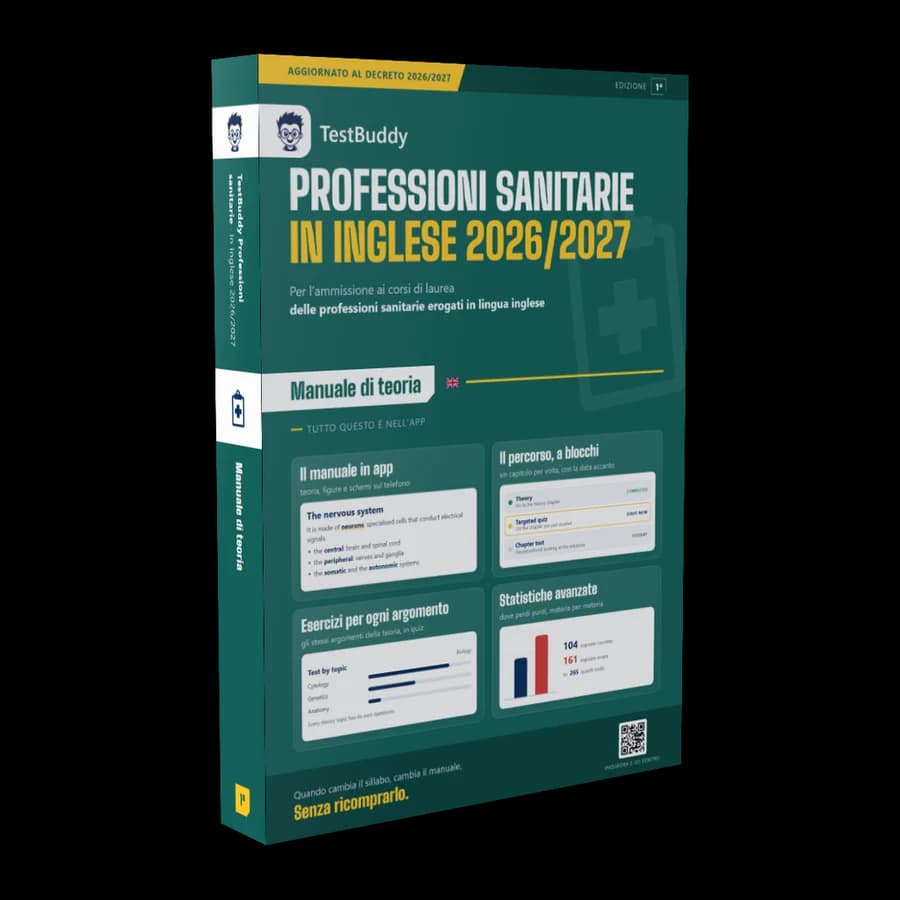
📘 Il manuale TestBuddy
Il manuale di teoria per Test Professioni Sanitarie (EN)
Tutta la teoria, capitolo per capitolo, già dentro l'app: la studi da telefono e da computer, ed è inclusa nell'abbonamento.
- Tutte le materie del programma, spiegate in modo chiaro
- Quiz collegati a ogni capitolo, per mettere subito in pratica
- Si aggiorna quando cambia il programma, senza ricomprare niente
Guide utili per iniziare
Tutto quello che ti serve sapere per prepararti al meglio


Scritto e verificato da
Redazione TestBuddy
Un team di docenti, tutor e professionisti specializzati nella preparazione ai test di ammissione universitari e concorsi pubblici. Ogni guida viene redatta, revisionata e aggiornata per offrirti informazioni accurate e affidabili.