
Healthcare Professions English Test 2026 rankings
Guide to the Healthcare Professions admission test in English 2026: scoring, rankings, sliding rounds and places.


Anyone preparing for the 2026 Healthcare Professions admission test in English mainly needs to understand 4 things: how much each answer is worth, what score may actually be needed to get in, how the ranking works, and what happens if a place is not assigned immediately.
For 2026, several official details are already confirmed: we know the test date, scoring system, tie-breaking criteria, and general ranking rules. Actual admission cutoffs, however, can only be known after the test because they vary by university, degree course, candidate quota, and ranking rounds.
Here is what really matters when reading your result.
2026 Healthcare Professions test date in English
The admission test for Healthcare Professions degree courses taught in English is scheduled for:
17 September 2026 at 11:00 a.m.
The test lasts 100 minutes.
The Healthcare Professions test in Italian will instead take place on 16 September 2026 at 11:00 a.m.
At some universities, students may apply for both tests, provided they complete the separate application procedures required by each call for applications. The University of Parma, for example, explicitly allows this in 2026.
How the 2026 score is calculated
The scoring system remains unchanged in 2026.
| Answer | Score |
|---|---|
| Correct | +1.5 points |
| Incorrect | -0.4 points |
| Unanswered | 0 points |
The test includes 60 questions, with a maximum score of 90 points.
To be considered eligible, candidates must obtain a total score above 0.
However, this should not be confused with the score actually required to secure a place.
A student can technically be eligible with a very low score and still be far from an admission position in the ranking.
During preparation, it is therefore more useful to track how competitive your score is compared with previous rankings.
With TestBuddy, students can use full-length simulations and the TB™ Score to monitor their current level and see how their test performance is improving over time. You can start for free.
What is the minimum score needed to get in?
There is no fixed national minimum score that guarantees admission to Healthcare Professions courses taught in English.
There are 2 different values that should not be confused:
- eligibility threshold: more than 0 points;
- score of the last admitted candidate, commonly referred to as the cutoff: this changes for each ranking.
The cutoff mainly depends on:
- number of available places;
- number and scores of the other candidates;
- degree course;
- university;
- candidate quota;
- withdrawals;
- subsequent ranking rounds.
This is why there is no 2026 cutoff yet: the test will take place on 17 September 2026, and rankings will only be published afterwards.
Previous cutoffs: official examples
Historical scores can help students understand the level of competition, but they cannot predict the 2026 cutoff with certainty.
In 2025, for example:
- Nursing at Sapienza University of Rome: 17 places for European Union candidates and equivalent categories. The candidate ranked 17th in the initial ranking scored 43.80 points. The next candidate scored 42.80.
- Nursing at the University of Palermo: 35 final places for European Union candidates and equivalent categories. The candidate ranked 35th scored 47.700 points. The 36th candidate scored 47.000.
- Dental Hygiene at the University of Parma: in the corrected ranking published on 8 October 2025, the 12th admitted candidate scored 12.30 points. The next candidate scored 11.80.
The difference between these figures shows why a single national cutoff would be misleading.
The most useful comparison is always with the same degree course, the same university, and the same candidate quota.
It is also important to distinguish between the score of the last admitted candidate in the initial ranking and the score of the last student admitted after later ranking rounds.
How many places are available in 2026?
Places for the 2026/2027 academic year were defined at ministerial level on 7 August 2026.
Planning is national, but places are distributed by degree course and university.
This means there is no single figure that is particularly useful for a student applying to one specific English-taught course. What matters is the number of places assigned to that specific course and university.
Places are also generally divided between:
- European Union candidates and equivalent categories;
- non-European Union candidates residing abroad.
Examples from 2026 university calls include:
- Sapienza, Nursing in English: the call initially listed 18 places for European Union candidates and equivalent categories and 1 place for non-European Union candidates residing abroad, while specifying that these numbers were provisional;
- Palermo, Nursing in English: 36 provisional places for European Union candidates and equivalent categories and 26 provisional places for non-European Union candidates residing abroad;
- Parma, Dental Hygiene in English: 12 places for Italian, European Union and equivalent candidates and 8 places for non-European Union candidates residing abroad.
For some universities, the 2026 figures may still need to be completed or updated following the final ministerial allocation.
Is the ranking national or local?
For Healthcare Professions taught in English, there is no single national ranking.
The system is managed locally.
Each university:
- organises its own admission procedure;
- collects the course preferences required by its call;
- ranks candidates according to their scores;
- assigns the available places;
- manages withdrawals and later ranking rounds.
So although admission is nationally regulated, the actual ranking is university-based.
Separate rankings are also created for the different candidate quotas.
How preferences work
When a university offers several degree courses through the same admission procedure, candidates may be asked to indicate an order of preference.
The exact rules depend on the university call.
At Parma, for example, candidates can indicate up to 3 options in 2026. The chosen order is binding and continues to apply during later procedures used to fill vacant places.
Preferences should therefore not be treated as a simple indication with no consequences: they can directly affect the final assignment.
How ranking rounds work
Not being admitted in the first ranking does not necessarily mean being excluded.
When an admitted candidate:
- withdraws;
- does not complete enrolment by the deadline;
- loses the right to the place under the rules of the call;
the place may be offered to the next candidate in the ranking.
Ranking rounds continue according to the schedule set by each university.
There is no single national calendar for all universities.
🎯 Simulatore Test Professioni Sanitarie (EN)
Scopri a che punto sei davvero
Simulazioni cronometrate come il test reale, domande aggiornate e correzioni commentate: in 20 minuti sai quanto sei pronto.
Simulazione Test Professioni Sanitarie (EN) gratisGratis · 100.000+ studenti · 4.4★ su App Store e Google Play
How long can ranking rounds continue in 2026?
Timing varies significantly between universities.
For example, Sapienza currently schedules the following for Nursing in English:
- ranking published by 23 September 2026;
- enrolment deadline for initially admitted candidates: 30 September 2026;
- 1st reassignment: 5 October 2026;
- 2nd reassignment: 12 October 2026;
- 3rd reassignment: 19 October 2026;
- 4th reassignment: 26 October 2026;
- possible further reassignments by 11 December 2026.
At Palermo, the 2026 call provides for:
- enrolment deadline for initially admitted candidates: 25 September 2026;
- first ranking round: 29 September 2026;
- enrolment deadline for the first ranking round: 6 October 2026;
- possible further ranking rounds afterwards.
At Parma, ranking rounds are scheduled on a weekly basis, with the ordinary procedure continuing until 30 November 2026.
This means admission may still happen several weeks after the first ranking is published.
Withdrawals and places becoming available
A withdrawal or failure to enrol can free up a place for a candidate lower in the ranking.
Students who are eligible but not admitted should therefore follow university publications carefully and comply with any procedures required to remain interested in the place.
In some cases, places initially reserved for non-European Union candidates residing abroad may also become available.
If these places remain unused and the required conditions are met, they may be reassigned to the ranking for European Union candidates and equivalent categories.
Can I still get in after my university ranking is exhausted?
In 2026, there is an additional possibility under the ministerial rules.
If a university:
- has completed its ranking rounds;
- has exhausted its ranking;
- still has vacant places;
it may publish a new call open also to candidates who took the same type of admission test at another university but were not admitted.
Candidates are then ranked according to the score they obtained until all remaining places are filled.
This still does not create a single national ranking. The procedure is managed by the individual university that still has places available.
The dates of these possible calls are not available as of 11 August 2026, because they will depend on the number of places still vacant after the regular ranking rounds.
Where to check your score and result
There is no single national portal where all Healthcare Professions candidates in English can view their ranking.
Results are published through the university's own official systems, such as:
- student portal;
- official online notice board;
- dedicated admissions page;
- degree course page.
Depending on the university, students may be able to see:
- total score;
- ranking position;
- candidate status;
- admission status;
- enrolment instructions.
The format is not identical across all universities.
Universitaly remains the official ministerial portal for several university procedures, but it does not host a single national ranking for Healthcare Professions in English.
When are 2026 results published?
There is one national test date for the English-language test: 17 September 2026.
There are therefore no separate national test sessions that produce different rankings.
After the test, universities begin publishing their local:
- results;
- initial rankings;
- enrolment deadlines;
- ranking rounds.
Dates vary by university.
Sapienza, for example, expects to publish the ranking by 23 September 2026.
Palermo does not state an exact date for the first ranking in the call reviewed, although it already specifies some of the following enrolment and ranking-round deadlines.
Parma manages its result publications and later reassignment procedures through its institutional portal.
Is there a single final national ranking?
No.
Even after all ranking rounds have ended, there is no final national ranking containing every Healthcare Professions candidate in English.
Each university completes its admission procedure independently.
Any later calls designed to fill remaining vacant places are also managed by the individual university.
What happens if 2 candidates have the same score?
If 2 or more candidates obtain the same total score, ranking priority is determined by comparing, in order, the score obtained in:
- Biology
- Chemistry
- Physics and Mathematics
- Logical Reasoning
- Reading Skills and Knowledge Acquired During Previous Studies
If the tie remains, the additional criteria established for specific documented disability or invalidity conditions are applied.
If candidates are still tied, the younger candidate is ranked first.
If I do not get in immediately, can I still be admitted later?
Yes, as long as the ranking continues to move.
The main possibilities are:
- another candidate withdraws;
- another candidate fails to enrol by the deadline;
- further ranking rounds are published;
- unused places are redistributed where permitted;
- another university publishes a call for still-vacant places.
Being outside the available places in the first ranking therefore does not automatically mean permanent exclusion.
Your ranking position matters, but so does how far the ranking ultimately moves.
What to do if you are not admitted
Before considering the admission process finished, students should check whether the following have ended:
- all scheduled ranking rounds;
- any procedures used to recover vacant places;
- any additional calls for places that remain available.
Where permitted, candidates may also request access to administrative records to review their test and verify the admission procedure.
The individual calls and applicable rules may also provide formal legal remedies. There is no single national deadline applying to every possible appeal against every Healthcare Professions ranking, so the relevant terms must be checked in the documentation issued by the university involved.
A gap year is not an official procedure defined by the admission documents.
If a student decides to take the test again the following year, preparation can be organised by tracking performance in a measurable way. TestBuddy brings together simulations, practice questions, a digital manual, statistics, and TB™ Score in one study path, with the option to start for free.
Official references used for this update
The 2026 rules on test date, scoring, rankings, tie-breaking criteria, vacant places, and procedures following the regular ranking rounds come from the official ministerial decree on the 2026 admission procedure.
The ministerial allocation of places for the 2026/2027 academic year is reported in the official Ministry of University and Research document on Healthcare Professions places.
The ranking and reassignment dates used as an example for Nursing come from the 2026/2027 Sapienza University of Rome admission call, while the historical 43.80-point figure comes from the official 2025 Sapienza ranking.
The 2026 data for Nursing at Palermo come from the official University of Palermo admission call, while the historical 2025 cutoff used as an example comes from the official 2025 Palermo ranking.
The 2026 rules for Dental Hygiene, preferences, participation in both the Italian-language and English-language tests, and ranking rounds come from the official 2026/2027 University of Parma admission call, while the historical 12.30-point figure comes from the official corrected Parma ranking published on 8 October 2025.
For Nursing at the University of Campania Luigi Vanvitelli, as of 11 August 2026, the new admission call had not yet been published on the institutional degree course page; the comparison with the previous year's procedure comes from the official 2025/2026 Nursing admission call.
🎯 Simulatore Test Professioni Sanitarie (EN)
Scopri a che punto sei davvero
Simulazioni cronometrate come il test reale, domande aggiornate e correzioni commentate: in 20 minuti sai quanto sei pronto.
Simulazione Test Professioni Sanitarie (EN) gratisGratis · 100.000+ studenti · 4.4★ su App Store e Google Play
Ti è stata utile questa guida?
Aiutaci a migliorare lasciando una valutazione
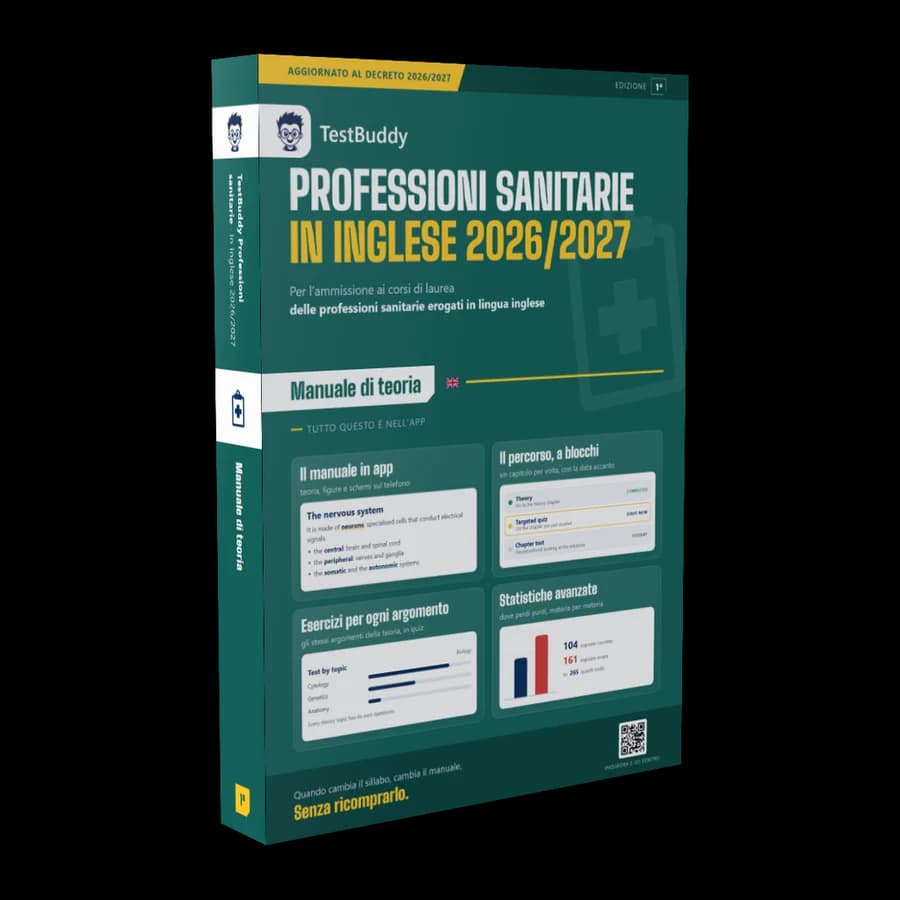
📘 Il manuale TestBuddy
Il manuale di teoria per Test Professioni Sanitarie (EN)
Tutta la teoria, capitolo per capitolo, già dentro l'app: la studi da telefono e da computer, ed è inclusa nell'abbonamento.
- Tutte le materie del programma, spiegate in modo chiaro
- Quiz collegati a ogni capitolo, per mettere subito in pratica
- Si aggiorna quando cambia il programma, senza ricomprare niente
Guide utili per iniziare
Tutto quello che ti serve sapere per prepararti al meglio


Scritto e verificato da
Redazione TestBuddy
Un team di docenti, tutor e professionisti specializzati nella preparazione ai test di ammissione universitari e concorsi pubblici. Ogni guida viene redatta, revisionata e aggiornata per offrirti informazioni accurate e affidabili.