
Healthcare Professions English Test 2026 Guide
Clear and updated guide to the English-taught Healthcare Professions admission test 2026: rules, scoring, registration and stress-free preparation.


The English-taught Healthcare Professions admission test is required to access Healthcare Professions degree programmes taught in English that have limited enrolment.
For 2026, the framework is already defined: we know the test date, structure, scoring criteria and official syllabus. Registration deadlines, application fees, test venues and several administrative procedures, however, still depend on the individual university.
Here you’ll find a complete overview of what you need to know before the test, with links to dedicated guides whenever you want to go deeper.
What’s new and when the 2026 Healthcare Professions test in English takes place
The 2026 Healthcare Professions test in English is scheduled for Thursday, September 17, 2026 at 11:00 a.m.
The test still lasts 100 minutes, while the overall structure and scoring system remain substantially in line with 2025.
Keep in mind that the university may ask candidates to arrive well before 11:00 a.m. for identification and admission to the test room.
If you want to see what has changed compared with previous years, we have a dedicated guide to the 2026 test updates.
How the test is structured
The test consists of 60 multiple-choice questions, each with 5 answer options, to be completed in 100 minutes.
The questions cover:
- reading skills and knowledge acquired during previous studies;
- logical reasoning and problem solving;
- biology;
- chemistry;
- physics and mathematics.
For the English-taught test, the questions are written in English. The topics to study are those included in the official 2026 syllabus.
If you want the exact breakdown of the questions and the full list of topics, see our guide to the test structure and syllabus.
How to register
There is no single registration procedure that applies to every university.
You need to choose the university where you want to sit the test, read its admission notice and complete the required steps before the deadline, including:
- registration on the university portal;
- submission of the application;
- selection of degree programmes in order of preference, where required;
- payment of the application fee.
Deadlines vary from one university to another. In 2026, for example, some universities set registration deadlines in the first days of September.
If you want to avoid administrative mistakes, we have explained the process in our guide on how to register for the test.
How old do you need to be to take the test?
There is no specific national minimum age for taking the test.
What matters is having the qualification required for university admission, or obtaining it within the year specified in the admission notice.
This means that a minor may also be eligible to take the test. In that case, some universities may require additional forms or documents signed by a parent or legal guardian, especially during enrolment.
For this reason, the admission notice published by your chosen university should always be checked carefully.
Scoring and rankings
The maximum score is 90 points.
The scoring system is:
- +1.5 points for each correct answer;
- -0.4 points for each incorrect answer;
- 0 points for each unanswered question.
To be included in the ranking, you need to obtain a score above 0.
Rankings are managed by the universities and are separated between European Union candidates and equivalent non-European Union candidates, on the one hand, and non-European Union candidates residing abroad, on the other. Publication dates, enrolment deadlines and ranking updates also depend on the individual university.
For more details on tie-breaking rules and ranking updates, see our guide to scoring and rankings.
🎯 Simulatore Test Professioni Sanitarie (EN)
Scopri a che punto sei davvero
Simulazioni cronometrate come il test reale, domande aggiornate e correzioni commentate: in 20 minuti sai quanto sei pronto.
Simulazione Test Professioni Sanitarie (EN) gratisGratis · 100.000+ studenti · 4.4★ su App Store e Google Play
How much the test costs
There is no single national fee for taking the test.
The application fee is set by each university. In the 2026 admission notices already published, for example, we find fees of €35 and €50 for registration.
This payment only covers participation in the admission test. If you are admitted, you will then need to consider university tuition fees, the regional student tax, stamp duty and any other charges required by the university.
The overall cost of university can also vary depending on the student’s financial situation.
We have covered these differences in our guide to test and university costs.
Is there an official question bank?
At the moment, there is no published national official 2026 question bank from which the Healthcare Professions test in English is drawn.
The main official reference for understanding what may be tested remains the ministerial syllabus.
Some universities do publish tests used in previous years. These can be useful for becoming familiar with the format, but they are not a question bank from which the 2026 questions will necessarily be selected.
If you are looking for practice material, you can find more details in our guide to simulations and practice questions.
How to prepare
Preparation should start from 3 elements: the official syllabus, topic-based practice and full-length simulations.
Simulations are also useful for training your time management over the 100-minute test and understanding how wrong-answer penalties affect your final score.
On TestBuddy, you can prepare with realistic simulations, topic-based exercises, a digital manual, performance statistics, the TB™ Score to estimate how you would perform if you took the test today, and Buddy, the artificial intelligence assistant. You can start for free.
To organise your study without making this page unnecessarily long, see our complete guide on how to prepare.
Extra time for disabilities and specific learning disorders
Candidates with valid documentation may request specific accommodations for the test.
The 2026 rules allow up to 50% additional time for candidates with disabilities and up to 30% additional time for candidates diagnosed with specific learning disorders.
There is no single national deadline for submitting these requests. You need to send your documentation and application according to the procedure established by the university.
In 2026, for example, some universities set these deadlines at the same time as the registration deadline, in the first days of September. It is therefore worth preparing the required documentation well in advance.
Non-European Union candidates
The procedure varies depending on the candidate’s status.
Candidates who are treated as equivalent to European Union applicants take part in the corresponding ranking. Candidates residing abroad compete for reserved places and, where required, must also complete pre-enrolment through Universitaly and the study visa procedure.
Pre-enrolment on Universitaly does not replace registration for the admission test at the university.
Deadlines can also fall much earlier than the test date. If you live abroad, it is therefore important to check the university admission notice several months before the test.
What to bring on test day
The required documents are specified in the admission notice published by the university.
In general, you should bring a valid identity document and anything else required by the university to complete the identification process. Some international candidates may also need to bring a passport, visa or other documents related to their status.
The test venue, arrival time and access rules may also vary from one university to another.
Before leaving home, it is therefore worth checking our guide on what to bring on test day together with the instructions in your university’s admission notice.
The first thing you should always check is the admission notice published by the university where you want to take the test. This is where you will find the registration procedure, deadlines, application fee, arrival time and university-specific requirements.
Once the administrative side is sorted, you can focus on the test structure, syllabus and simulations. Knowing exactly how the test works makes it much easier to organise your preparation without wasting time.
Official 2026 overview
The September 17, 2026 test date, duration, structure, scoring system and general rules are set out in the official ministerial framework for 2026 and the related official subject syllabus.
Differences between universities in terms of registration, fees and deadlines can be seen, for example, in the official admission notices published by Sapienza University of Rome and the University of Parma.
For international candidates, the institutional reference is Universitaly, while candidates looking for practice material published directly by a university can also use the University of Udine archive of previous admission tests.
🎯 Simulatore Test Professioni Sanitarie (EN)
Scopri a che punto sei davvero
Simulazioni cronometrate come il test reale, domande aggiornate e correzioni commentate: in 20 minuti sai quanto sei pronto.
Simulazione Test Professioni Sanitarie (EN) gratisGratis · 100.000+ studenti · 4.4★ su App Store e Google Play
Ti è stata utile questa guida?
Aiutaci a migliorare lasciando una valutazione
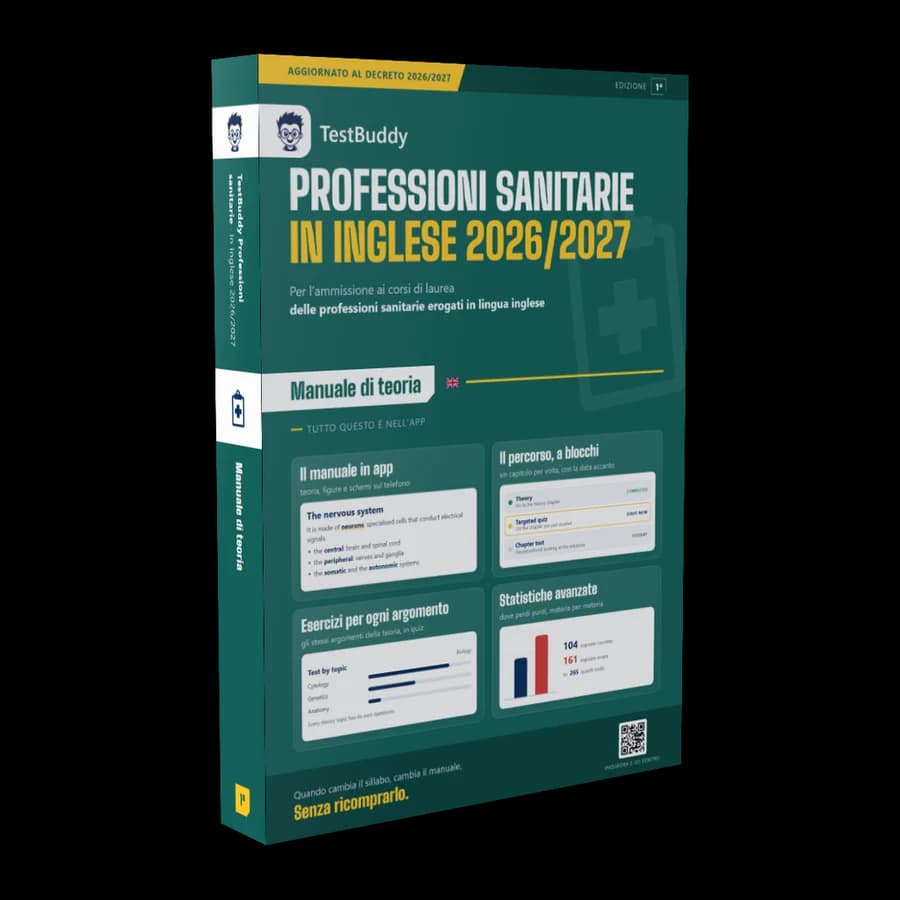
📘 Il manuale TestBuddy
Il manuale di teoria per Test Professioni Sanitarie (EN)
Tutta la teoria, capitolo per capitolo, già dentro l'app: la studi da telefono e da computer, ed è inclusa nell'abbonamento.
- Tutte le materie del programma, spiegate in modo chiaro
- Quiz collegati a ogni capitolo, per mettere subito in pratica
- Si aggiorna quando cambia il programma, senza ricomprare niente
Guide utili per iniziare
Tutto quello che ti serve sapere per prepararti al meglio


Scritto e verificato da
Redazione TestBuddy
Un team di docenti, tutor e professionisti specializzati nella preparazione ai test di ammissione universitari e concorsi pubblici. Ogni guida viene redatta, revisionata e aggiornata per offrirti informazioni accurate e affidabili.