
What to Bring on the Healthcare Professions Exam Day
Clear guide on what to bring on the Healthcare Professions English admission test: mandatory documents, prohibited items, and official rules.


The 2026 English-taught Healthcare Professions admission test will take place on 17 September 2026. Besides preparing for the exam itself, students need to know exactly what to bring, what to leave at home, and when to arrive.
Below we cover the documents to bring, the items that may cause problems at the entrance, how to organize your bag, what happens during identification, and what to do in case of delays or unexpected issues. We also explain what to check the day before, which rules apply to students with disabilities or Specific Learning Disorders, and what the official regulations say about managing the exam day.
What to bring to the 2026 English-taught Healthcare Professions test
The first thing to prepare is the documentation required by your university.
The 2026 admission notices we reviewed require, depending on the university:
- a valid identity document;
- the payment receipt for the admission fee, when required;
- any additional documents specifically requested by the university.
The payment receipt can be particularly important because procedures vary between universities.
At Sapienza University of Rome, for example, candidates must show both a valid identity document and the receipt proving payment of the €35 admission fee during identification.
At the University of Palermo, candidates must present a valid identity document and keep the receipt for the €60 admission fee, which must be shown to the commission if requested. If a candidate does not appear on the list of admitted applicants, the receipt is required for conditional admission.
The official notices reviewed do not indicate a general self-certification document that every candidate must bring to the exam room.
For this reason, students should always follow the document list published in the admission notice of their own university, without assuming that all institutions use exactly the same procedure.
What is prohibited in the exam room
Rules on permitted items can be very strict.
Depending on the university, the 2026 official notices reviewed prohibit:
- smartphones and mobile phones;
- smartwatches;
- tablets and other electronic devices;
- earphones and headphones;
- books;
- notes;
- personal sheets of paper;
- reference material;
- bags and backpacks kept with you during the exam.
At the University of Palermo, the prohibition explicitly includes webcams and similar devices.
Possession of prohibited material during the exam may result in exclusion from the test and removal from the exam room.
Can you bring a calculator?
A calculator should not be considered a normally permitted item.
In the official documents reviewed, calculators appear only as a possible compensatory measure for candidates with Specific Learning Disorders, subject to the conditions established by the university and prior authorization.
At the University of Palermo, for example, a non-scientific calculator may be authorized in cases of particular severity supported by appropriate certification.
This does not mean that all candidates may bring one.
Without specific authorization from the university, a calculator should not be considered part of the material to bring to the test.
Pens, pencils and writing materials
Students should also check their university notice for the rules on writing materials.
At some universities, personal writing materials cannot be used.
In the 2026 University of Palermo notice, for example, candidates are not allowed to bring or use:
- personal pens;
- pencils;
- stationery;
- blank sheets of paper;
- other personal writing materials.
The materials required for the exam are provided according to the procedures established by the university.
For this reason, students should not assume that they will be allowed to use their own pen during the test.
How to organize your bag
Your bag should contain only what is genuinely necessary to reach the venue and complete the identification procedure.
A basic checklist is:
- valid identity document;
- payment receipt, when required by the university;
- any additional documents specifically requested by your institution;
- only essential personal belongings needed before and after the exam.
Avoid filling your bag with materials you will not be allowed to use during the test.
At some universities, bags and backpacks must be left outside the exam room or in an area indicated by the commission.
The University of Palermo also states that the university does not guarantee supervision of belongings left in the designated area and is not responsible for theft or loss.
It is therefore better not to bring unnecessary valuables.
What time should you arrive?
The English-taught Healthcare Professions test is scheduled for 17 September 2026, but the reporting time is not necessarily the same at every university.
In the official examples reviewed, the test starts at 11:00, but entrance procedures begin much earlier.
| University | Reporting time | Test start |
|---|---|---|
| Sapienza University of Rome | 09:00 | 11:00 |
| University of Palermo | 08:00 | 11:00 |
Students should therefore not use 11:00 as their arrival time.
The relevant time is the reporting time stated by the university where the test is being taken.
At Sapienza, exam rooms are expected to be published by 15 September 2026.
The day before the test, it is therefore important to check the venue, building, room and reporting time published by your university.
What happens at the entrance?
Before the test begins, candidates go through an identity verification procedure.
The commission checks the identity document and verifies the information required by the admission notice.
Candidates then receive the operational instructions and the materials needed for the test.
At Sapienza, for example, candidates receive the exam materials, the answer sheet and a pre-printed personal information sheet.
All these procedures take place before the actual test starts, which is why the official reporting time may be several hours before 11:00.
🎯 Simulatore Test Professioni Sanitarie (EN)
Scopri a che punto sei davvero
Simulazioni cronometrate come il test reale, domande aggiornate e correzioni commentate: in 20 minuti sai quanto sei pronto.
Simulazione Test Professioni Sanitarie (EN) gratisGratis · 100.000+ studenti · 4.4★ su App Store e Google Play
What happens if you arrive late?
There is no universal rule allowing candidates to arrive a few minutes after the official reporting time.
The procedure established by your university must be followed.
The University of Palermo notice is particularly clear: candidates who arrive after the test booklet has been distributed are not admitted to the identification procedure, even if they arrive before 11:00.
This means that arriving before the official test start does not automatically guarantee admission.
The date and time stated in the official reporting instructions should therefore be treated as the deadline to respect.
What to do the day before the test
There are no special ministerial procedures that must be completed the day before, but all logistical details should already be under control.
Check:
- the exact test venue;
- the building and room, once published;
- the official reporting time;
- the validity of your identity document;
- the availability of any payment receipt required by your university;
- any official updates published by the institution.
It is also useful to prepare everything you need in advance, so you do not have to look for documents or receipts on the morning of the test.
Students who want to become familiar with the timing and structure of the exam can use TestBuddy for simulations, targeted exercises and performance statistics, including the TB™ Score, which helps track your current preparation level. You can start for free.
What to do the evening before
The evening before the exam should mainly be used to avoid preventable organizational problems.
Make sure you already have ready:
- your identity document;
- your receipt, if required;
- directions to the venue;
- the exact reporting time.
The official 2026 documents reviewed do not prescribe a specific diet, particular foods to eat or avoid, a required number of hours of sleep, or specific relaxation techniques for the evening before the test.
There is therefore no official routine candidates are required to follow before the exam.
Food before the test
The official rules reviewed do not provide specific dietary instructions for the day before or the morning of the exam.
They do not prescribe:
- specific foods;
- specific quantities;
- particular drinks;
- foods to avoid;
- mandatory meal times.
It would therefore be incorrect to present a particular diet as part of the official rules for the 2026 English-taught Healthcare Professions admission test.
How to manage your time during the test
The test lasts 100 minutes.
The official rules do not state how many minutes should be spent on each question, in which order questions should be answered, or how much time should be reserved for final review.
There is therefore no mandatory ministerial time-management strategy.
This is something students can make familiar during their preparation by practising complete simulations under the same time limit.
With TestBuddy, students can take simulations and use performance statistics and the TB™ Score to monitor how their preparation develops over time, making the real test format progressively more familiar.
How to manage anxiety in the exam room
The official test rules do not prescribe specific techniques for managing anxiety.
There are no mandatory breathing, relaxation or mental-control procedures to follow during the exam.
Inside the room, the priority is to follow the commission's instructions, use only authorized materials and avoid communicating with other candidates.
Universities may provide their own psychological support services, but these are not part of a specific procedure for the 17 September 2026 admission test.
Mistakes to avoid on exam day
The most important mistakes are those that can cause problems during identification or lead to exclusion.
Avoid:
- arriving without a valid identity document;
- forgetting the payment receipt, when required by your university;
- using the test start time instead of the official reporting time as your arrival reference;
- keeping smartphones, smartwatches or other prohibited devices with you during the exam;
- using books, notes or personal sheets of paper;
- using writing materials that are not permitted by your university;
- communicating with other candidates during the test;
- using a calculator without specific authorization.
The exact rules depend on the admission notice published by the university where you take the test.
Students with disabilities and Specific Learning Disorders
Students with disabilities or Specific Learning Disorders may be entitled to specific accommodations, but these must be requested according to the procedures and deadlines established by the university.
At Sapienza, requests for the 2026 test must be completed by 3 September 2026, together with the required documentation.
At the University of Palermo, requests must be submitted by 24 August 2026.
At Palermo, candidates with disabilities or recognized invalidity may receive up to 50% additional time.
Candidates with Specific Learning Disorders may receive up to 30% additional time.
Where permitted, specific compensatory tools may also be authorized, including a non-scientific calculator.
These tools cannot be used freely by all candidates. They must form part of the accommodations formally approved by the university.
What to do in case of technical problems or unexpected issues
The official documents reviewed do not establish a single national procedure for technical problems that may occur during the test.
Inside the exam room, the operational reference is the commission and the staff responsible for the room.
Universities also publish their own contacts for administrative, technical or accessibility-related issues, but procedures vary between institutions.
Students should therefore follow the instructions published by the university where they are taking the test rather than applying procedures from another institution.
Official 2026 information
The 17 September 2026 test date, the 100-minute duration and the general test rules come from the official ministerial regulation for the 2026 Healthcare Professions admission test and the national admission test calendar published by the Italian Ministry of Universities and Research.
The examples relating to documents, reporting times, payment receipts and entrance procedures come from the 2026/2027 Sapienza University of Rome Nursing admission notice and the 2026/2027 University of Palermo English-taught Nursing admission notice.
Information on accommodations for disabilities and Specific Learning Disorders is also supported by the Sapienza institutional page on disabilities and Specific Learning Disorders.
🎯 Simulatore Test Professioni Sanitarie (EN)
Scopri a che punto sei davvero
Simulazioni cronometrate come il test reale, domande aggiornate e correzioni commentate: in 20 minuti sai quanto sei pronto.
Simulazione Test Professioni Sanitarie (EN) gratisGratis · 100.000+ studenti · 4.4★ su App Store e Google Play
Ti è stata utile questa guida?
Aiutaci a migliorare lasciando una valutazione
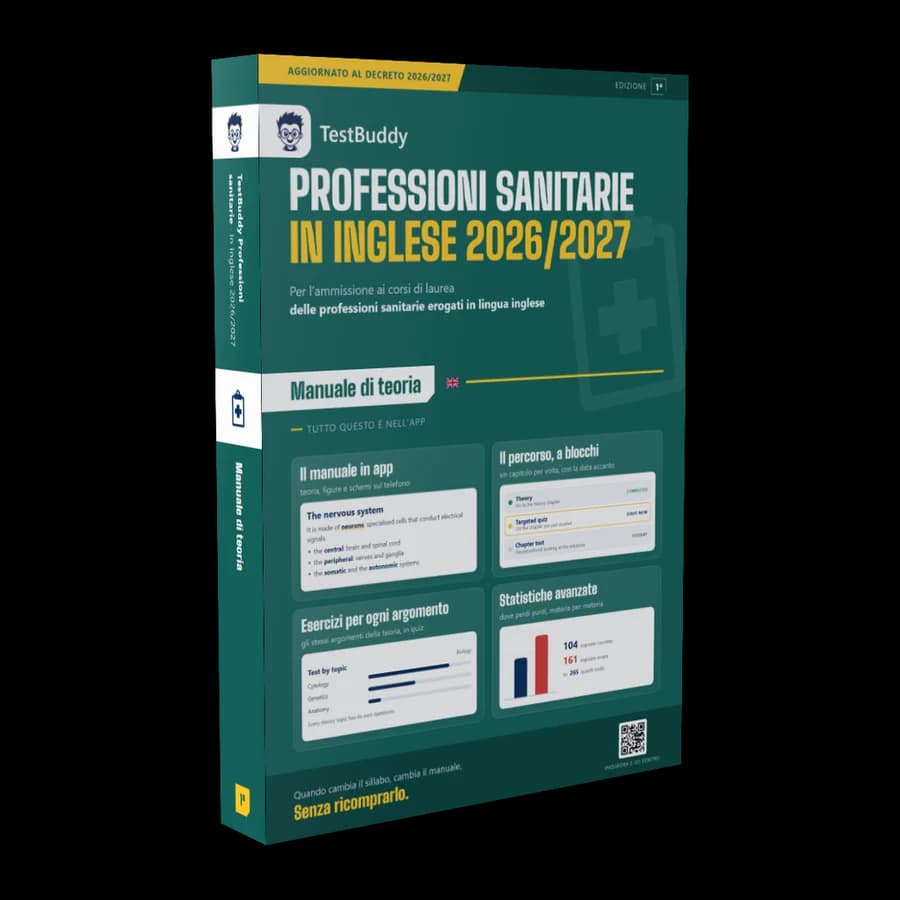
📘 Il manuale TestBuddy
Il manuale di teoria per Test Professioni Sanitarie (EN)
Tutta la teoria, capitolo per capitolo, già dentro l'app: la studi da telefono e da computer, ed è inclusa nell'abbonamento.
- Tutte le materie del programma, spiegate in modo chiaro
- Quiz collegati a ogni capitolo, per mettere subito in pratica
- Si aggiorna quando cambia il programma, senza ricomprare niente
Guide utili per iniziare
Tutto quello che ti serve sapere per prepararti al meglio


Scritto e verificato da
Redazione TestBuddy
Un team di docenti, tutor e professionisti specializzati nella preparazione ai test di ammissione universitari e concorsi pubblici. Ogni guida viene redatta, revisionata e aggiornata per offrirti informazioni accurate e affidabili.