
Healthcare Professions Test in English: 2026 Guide
Clear and official guide to the Healthcare Professions admission test in English: structure, subjects, study planning, and preparation without stress.


We have updated this guide with the official information available for 2026. Here we explain when the Healthcare Professions admission test in English takes place, how it is structured, which subjects to study, where to start if you are beginning from scratch, how to organize your preparation over 1, 3, or 6 months, and how to manage the final days before the exam.
The most important thing is to start from the actual structure of the test. Knowing how many questions there are, how much each subject weighs, and how the scoring system works makes it much easier to organize your study without wasting time.
Healthcare Professions test in English 2026: date
For the 2026/2027 academic year, the admission test for Healthcare Professions degree programs taught in English is scheduled for:
17 September 2026 at 11:00 AM.
In 2025, the test took place on 10 September 2025, so the date has changed.
The check-in time, test location, room, and identification procedures may vary between universities. For these details, students must always check the admission notice published by the university where they are applying.
How the test is structured in 2026
The test includes 60 multiple-choice questions, each with 5 answer options and only one correct answer.
The total time available is 100 minutes.
| Subject | Questions |
|---|---|
| Biology | 23 |
| Chemistry | 15 |
| Physics and Mathematics | 13 |
| Logical Reasoning and Problem Solving | 5 |
| Reading Skills and Knowledge Acquired During Previous Studies | 4 |
| Total | 60 |
This distribution has remained substantially unchanged compared with 2025.
Scientific subjects therefore make up most of the exam. Biology, Chemistry, Physics, and Mathematics account for 51 questions out of 60.
How the scoring system works
The scoring system is:
- +1.5 points for each correct answer
- -0.4 points for each incorrect answer
- 0 points for each unanswered question
Knowing the syllabus is therefore not enough. Students also need to learn how to manage time, uncertainty, and mistakes.
Practising without using the real scoring system can give a misleading idea of your actual level. From the beginning of your preparation, it is useful to practise with simulations based on 60 questions, 100 minutes, and the official penalty for incorrect answers.
Who prepares the test questions
The Ministry defines the general framework of the exam, including:
- the national test date;
- the subjects;
- the number of questions;
- the syllabus;
- the duration;
- the scoring system.
However, the actual test paper is prepared by each university.
This means there is not necessarily one identical test used across all Italian universities. Within each university, the test is organized according to the rules applying to the Healthcare Professions degree programs offered by that institution.
For preparation, students should therefore follow the common ministerial syllabus, while check-in times, test locations, and practical procedures must always be checked with the individual university.
Subjects and official syllabus
The 2026 ministerial syllabus confirms the same main subject areas already included in 2025.
Biology
Biology has the highest number of questions.
The main topics include:
- chemistry of living organisms;
- biological molecules and enzymes;
- prokaryotic and eukaryotic cells;
- cell membranes and transport;
- mitosis and meiosis;
- reproduction;
- Mendelian genetics;
- classical and molecular genetics;
- deoxyribonucleic acid and protein synthesis;
- human genetics and inherited diseases;
- mutations and evolution;
- biotechnology;
- human anatomy and physiology;
- homeostasis;
- energy metabolism;
- glycolysis, cellular respiration, and fermentation;
- photosynthesis.
With 23 questions, Biology should have a major role in your study plan.
Chemistry
The syllabus includes:
- structure of matter;
- states of matter;
- atomic structure;
- the periodic table;
- chemical bonds;
- inorganic chemistry;
- chemical reactions;
- stoichiometry;
- the mole and Avogadro's number;
- solutions and concentrations;
- chemical equilibrium;
- kinetics;
- oxidation-reduction reactions;
- acids, bases, and potential of hydrogen;
- buffer solutions;
- organic chemistry;
- major functional groups.
There are 15 Chemistry questions, making it the second-largest subject area in the test.
Mathematics
Topics include:
- number sets;
- ratios and percentages;
- powers, roots, and logarithms;
- algebra;
- polynomials;
- equations and inequalities;
- systems of equations;
- functions;
- trigonometry;
- plane and analytic geometry;
- probability;
- basic statistics.
Physics
Students need to study:
- physical quantities and units of measurement;
- vectors;
- kinematics;
- dynamics;
- work, energy, and power;
- momentum;
- fluid mechanics;
- thermodynamics;
- electricity;
- circuits;
- magnetism;
- electromagnetic induction.
Physics and Mathematics together account for 13 questions.
Logical Reasoning and Problem Solving
This section assesses the ability to:
- complete a line of reasoning correctly;
- use the information provided in the premises;
- identify logical relationships;
- solve problems expressed verbally or symbolically.
There are 5 questions.
Reading Skills and Knowledge Acquired During Previous Studies
This section includes:
- reading comprehension;
- interpretation of information;
- coherence and relationships between parts of a text;
- inference;
- historical and cultural knowledge;
- major national and international institutions;
- basic topics related to citizenship, society, and economics.
For degree programs taught in English, individual university admission notices may explicitly confirm that the questions are written in English.
🎯 Simulatore Test Professioni Sanitarie (EN)
Scopri a che punto sei davvero
Simulazioni cronometrate come il test reale, domande aggiornate e correzioni commentate: in 20 minuti sai quanto sei pronto.
Simulazione Test Professioni Sanitarie (EN) gratisGratis · 100.000+ studenti · 4.4★ su App Store e Google Play
Where to start if you are beginning from scratch
There is no mandatory ministerial study order for students starting from zero.
The most useful starting point is therefore simple: test structure, official syllabus, and your current level.
A practical order is:
- understand how the 60 questions are distributed;
- read the full syllabus at least once;
- identify which topics you already know and which ones you do not;
- build the foundations of the scientific subjects first;
- gradually add exercises and practice questions;
- start full simulations once you have built a sufficient theoretical base.
Biology and Chemistry deserve particular consistency because together they account for 38 questions out of 60.
Physics and Mathematics should not be left until the end. They account for another 13 questions and often require practice as well as theoretical study.
To keep theory and practice in the same place, you can start using TestBuddy for free, with the digital theory manual, topic-based exercises, and full simulations inside the all-in-one app. The TB™ Score also helps you track your current test level over time.
How to organize your study over 6 months
With 6 months available, preparation can be gradual.
The initial priority should be building solid foundations, especially in the scientific subjects.
A possible structure is:
- use the first months mainly for theory and fundamentals;
- complete exercises immediately after each topic;
- review previously studied material regularly;
- gradually increase the number of simulations;
- use the final phase mainly for mistakes, speed, and full-test management.
In this situation, there is no need to rush immediately into full simulations. First, you need enough knowledge to make them genuinely useful.
How to organize your study over 3 months
With 3 months available, reducing wasted time becomes more important.
From the beginning, study should alternate between:
- essential theory;
- topic-based exercises;
- recovery of weak areas;
- simulations;
- analysis of mistakes.
Biology and Chemistry should remain central, without neglecting Physics and Mathematics.
Preparation becomes much more effective when you do not simply count how many answers are correct, but also track subject, topic, speed, and performance over time.
How to organize your study over 1 month
With only 1 month available, preparation should not be organized as if you had 6 months.
You need to identify quickly:
- topics that are already solid;
- weaknesses that can still be improved;
- recurring mistakes;
- subjects that are costing you the most points;
- time-management problems.
Simulations become much more important.
A significant part of your study should therefore alternate between targeted revision and practice, avoiding spending too much time on minor areas while major parts of the syllabus remain weak.
At this stage, having a simulator, exercises, the TestBuddy theory manual, and performance statistics in one place can save time by avoiding constant switching between different tools. You can start TestBuddy for free and use the TB™ Score to check whether your performance is actually improving.
How the official documents say students should prepare
The ministerial documents do not prescribe a specific study method.
They do not specify:
- a compulsory textbook;
- a required number of study hours;
- an official preparation calendar;
- how many simulations students should complete;
- a fixed order in which subjects should be studied.
The required knowledge is linked to the preparation developed during secondary school according to the educational guidelines for Italian high schools, technical institutes, and vocational institutes.
For students, the most concrete reference therefore remains the complete official syllabus.
Any 1, 3, or 6-month study plan is necessarily an organizational method, not a schedule prescribed by the Ministry.
Common preparation mistakes
Studying every subject in the same way
The number of questions varies significantly.
Biology has 23 questions, while Logical Reasoning has 5. Study time should reflect this difference without completely abandoning any section.
Studying theory only
Knowing a chapter does not automatically mean being able to answer a question quickly.
Each theory session should be followed by practice questions on the same topic.
Doing only practice questions
The opposite mistake also causes problems.
If you keep getting the same type of question wrong, you need to return to the theory and fix the underlying gap.
Ignoring the penalty for wrong answers
An incorrect answer is worth -0.4 points.
During practice, students should therefore use the real scoring system. Otherwise, simulation scores may not accurately represent actual exam performance.
Taking the first full simulation too late
The test gives you 100 minutes for 60 questions.
You also need to practise maintaining concentration, pace, and time control throughout the entire exam.
Not analysing mistakes
The final number of correct answers alone does not tell you enough.
You need to understand where mistakes happen and whether the problem comes from:
- theory;
- calculations;
- comprehension;
- reasoning;
- rushing;
- time management.
How to manage the final week
The test is scheduled for 17 September 2026, so the final week runs from 10 to 16 September 2026.
There is no compulsory ministerial routine for this period.
At this stage, it is useful to focus on:
- reviewing topics already studied;
- recurring mistakes;
- formulas and steps that are easy to forget;
- targeted exercises;
- some full simulations completed within 100 minutes;
- checking time management.
This is not the ideal time to open large sections of completely new material if doing so means neglecting topics that have already been studied.
What to do the day before
On 16 September 2026, the day before the test, the priority is to make sure all practical information is already under control.
Students should verify:
- the test location;
- the assigned room;
- the check-in time;
- required documents;
- any specific instructions in the university admission notice.
The national test start time is 11:00 AM on 17 September 2026, but individual universities may require candidates to arrive earlier.
For example, one 2026 university admission notice reviewed for this guide requires candidates to check in at 9:00 AM, while the test itself begins at 11:00 AM. The test start time should therefore not be treated automatically as the time you need to arrive.
For studying, a light final review of material you already know is more useful than an intense session on completely new topics.
Official references updated for 2026
The national test date of 17 September 2026 and the admission-test calendar are available in the official announcement from the Italian Ministry of Universities and Research.
The test structure, number of questions, duration, scoring system, and syllabus are defined in the official ministerial decree for Healthcare Professions admissions 2026/2027.
An example of how the national rules are applied to a degree program taught in English, including the language of the questions and check-in procedures, can be found in the 2026 admission notice for the English-taught Nursing program at Sapienza University of Rome.
The comparison with the previous admission cycle is based on the official 2025 admission notice for the same English-taught program.
🎯 Simulatore Test Professioni Sanitarie (EN)
Scopri a che punto sei davvero
Simulazioni cronometrate come il test reale, domande aggiornate e correzioni commentate: in 20 minuti sai quanto sei pronto.
Simulazione Test Professioni Sanitarie (EN) gratisGratis · 100.000+ studenti · 4.4★ su App Store e Google Play
Ti è stata utile questa guida?
Aiutaci a migliorare lasciando una valutazione
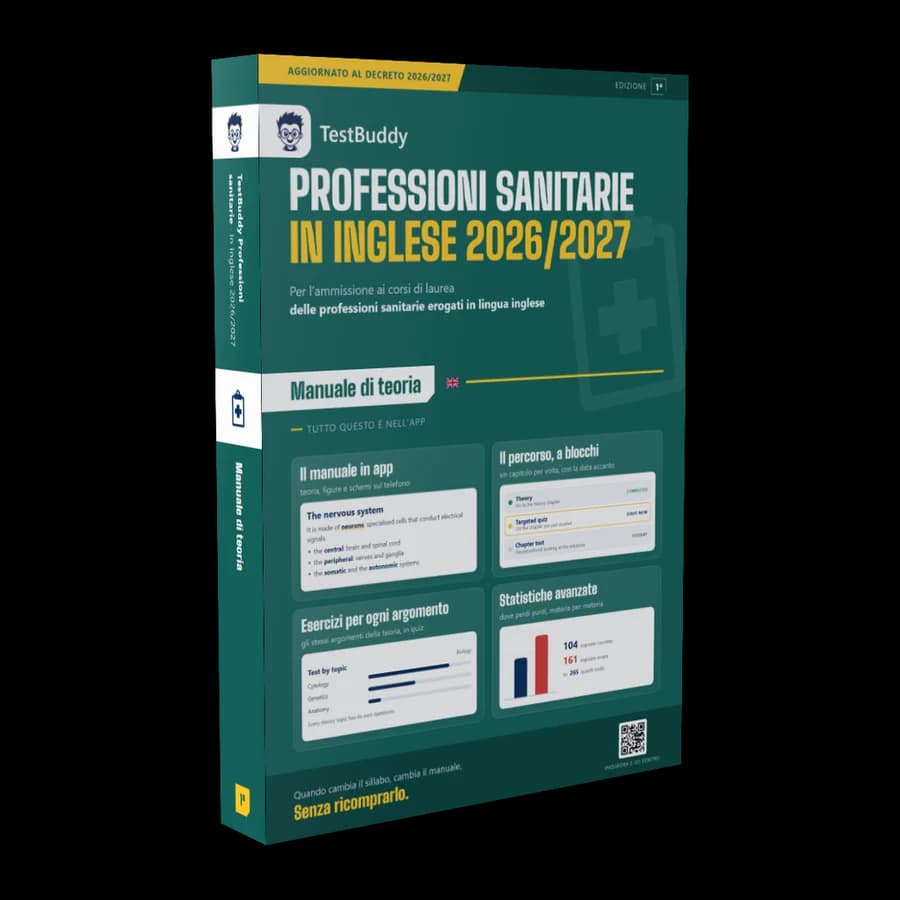
📘 Il manuale TestBuddy
Il manuale di teoria per Test Professioni Sanitarie (EN)
Tutta la teoria, capitolo per capitolo, già dentro l'app: la studi da telefono e da computer, ed è inclusa nell'abbonamento.
- Tutte le materie del programma, spiegate in modo chiaro
- Quiz collegati a ogni capitolo, per mettere subito in pratica
- Si aggiorna quando cambia il programma, senza ricomprare niente
Guide utili per iniziare
Tutto quello che ti serve sapere per prepararti al meglio


Scritto e verificato da
Redazione TestBuddy
Un team di docenti, tutor e professionisti specializzati nella preparazione ai test di ammissione universitari e concorsi pubblici. Ogni guida viene redatta, revisionata e aggiornata per offrirti informazioni accurate e affidabili.