
IMAT 2026 Test: official rules and preparation
Learn what is official about the IMAT 2026 test, what is still pending, and how to prepare effectively with clarity and confidence.


IMAT 2026 Test: what to know and how to prepare
When getting closer to the IMAT 2026 test, the first real obstacle is not studying, but understanding what is official, what has already been decided, and what has not yet been published. The questions are always the same: what are this year’s updates, what changes compared to last year, how scoring works, when and how to register, and above all how one should prepare without relying on assumptions.
In this article we go through all these points step by step, using only what emerges from the official ministerial documents already available, and clearly explaining what is confirmed and what, as of today, is still missing for 2026. The goal is to help students connect what they need to do in practice with the official rules, in a clear and calm way, without confusion or unnecessary stress.
Official updates for the IMAT 2026 test
As of 5 February 2026, no new admission notice specific to the IMAT test for the 2026 academic year has been published. This means that, at the moment, there are no officially formalized changes regarding the structure of the test, the scoring system, or the registration process for 2026.
The most recent and complete regulatory framework remains the one published for the previous year. From a practical point of view, the main update for 2026 is precisely this: the absence of a new ministerial decree. Until a new document is released, there are no legally valid modifications to rely on.
In this phase, preparing correctly means focusing on what is already defined and stable, avoiding adjustments based on unconfirmed expectations. This is where having access to realistic simulations and performance analysis becomes crucial, allowing students to stay on track even while official updates are pending.
Differences between IMAT 2025 and IMAT 2026
From a regulatory perspective, there are currently no official differences between the IMAT 2025 test and the IMAT 2026 test. A comparison between the two years cannot be based on changes in content or rules, because for 2026 no equivalent ministerial act has yet been published.
For 2025, the official documents clearly defined the test structure, number of questions, duration, scoring rules, calendar, and registration procedures. For 2026, all these elements have not yet been updated through an official decree.
As a result, until new documents are released, IMAT 2026 effectively follows the same framework as IMAT 2025. The real difference is not between two different tests, but between a fully regulated test and one that is still awaiting official confirmation.
Test structure, scoring system, registration, and requirements
The currently applicable test structure includes 60 multiple choice questions to be completed in 100 minutes, with questions written in English and covering logical reasoning, general knowledge, and scientific subjects. At present, there is no official document stating any change to this format for 2026.
The scoring system remains based on the same criteria: 1.5 points for each correct answer, -0.4 points for each incorrect answer, and 0 points for unanswered questions. No official variation has been announced for the upcoming year.
Regarding registration, the most recent cycle required online enrollment through the Universitaly portal within a specific time window, including the correct submission of personal data, required documents, and study preferences. Registration dates for IMAT 2026 have not yet been published, and they will only become valid once officially communicated.
The procedural requirements include accurate completion of the application, use of a valid email address, and strict compliance with deadlines. Under the latest available framework, the English language admission test applies to Medicine and Surgery, Dentistry and Dental Prosthetics, and Veterinary Medicine. No official confirmation or modification has yet been released for 2026.
At this stage, preparing means mastering the known format and training consistently under realistic conditions. Using a digital tool that mirrors the real structure, timing, and scoring helps build concrete confidence, not just theoretical knowledge.
🎯 Simulatore IMAT (Medicina inglese)
Scopri a che punto sei davvero
Simulazioni cronometrate come il test reale, domande aggiornate e correzioni commentate: in 20 minuti sai quanto sei pronto.
Simulazione IMAT (Medicina inglese) gratisGratis · 100.000+ studenti · 4.4★ su App Store e Google Play
How the current situation affects preparation for IMAT 2026
The lack of a new decree for 2026 has a very clear implication: what to study does not change, but how uncertainty is managed does. Since no structural changes have been officially documented, preparation should continue following the established model, without chasing hypothetical updates.
This makes realistic simulations, error analysis, and performance tracking even more important. When the regulatory framework is temporarily unchanged, having objective data about one’s progress allows for structured study and emotional control, and makes it easier to adapt quickly if official changes are introduced later.
An artificial intelligence based platform that analyzes results and highlights weaknesses supports a focused and stress free preparation, even while waiting for official updates.
Official reference timeline
The most recent fully documented cycle follows a precise timeline. On 14 May 2025, the ministerial notice announcing the dates of national admission tests was published, including IMAT. On 7 August 2025, the official ministerial decree regulating the test structure and content was issued. In the following weeks, additional notices and corrections were published.
For 2026, no equivalent official acts have yet been released. Until new documents appear, all reliable information must be traced back to this existing framework.
How to stay updated according to official rules
Official communications related to the IMAT test are issued through ministerial decrees and notices and through the Universitaly reserved area. Candidates are responsible for regularly checking these channels and monitoring the email address provided during registration.
The official documents do not mention a dedicated IMAT newsletter or a page explicitly labeled “last minute”. Updates with legal value are published exclusively as official acts, each with a clear publication and protocol date.
For this reason, during preparation it is essential to rely on verified sources and to follow a structured study path. Having a smart digital study companion that centralizes simulations, progress data, and performance analysis helps maintain clarity and focus throughout the entire preparation journey.
Official sources and documents
The information presented in this article is derived from the institutional documents regulating national admission procedures and the IMAT test, accessible through the official admission notice and related ministerial publications.
Summary of official sources:
- IMAT admission notice
- Official ministerial decree
- Universitaly portal
🎯 Simulatore IMAT (Medicina inglese)
Scopri a che punto sei davvero
Simulazioni cronometrate come il test reale, domande aggiornate e correzioni commentate: in 20 minuti sai quanto sei pronto.
Simulazione IMAT (Medicina inglese) gratisGratis · 100.000+ studenti · 4.4★ su App Store e Google Play
Ti è stata utile questa guida?
Aiutaci a migliorare lasciando una valutazione
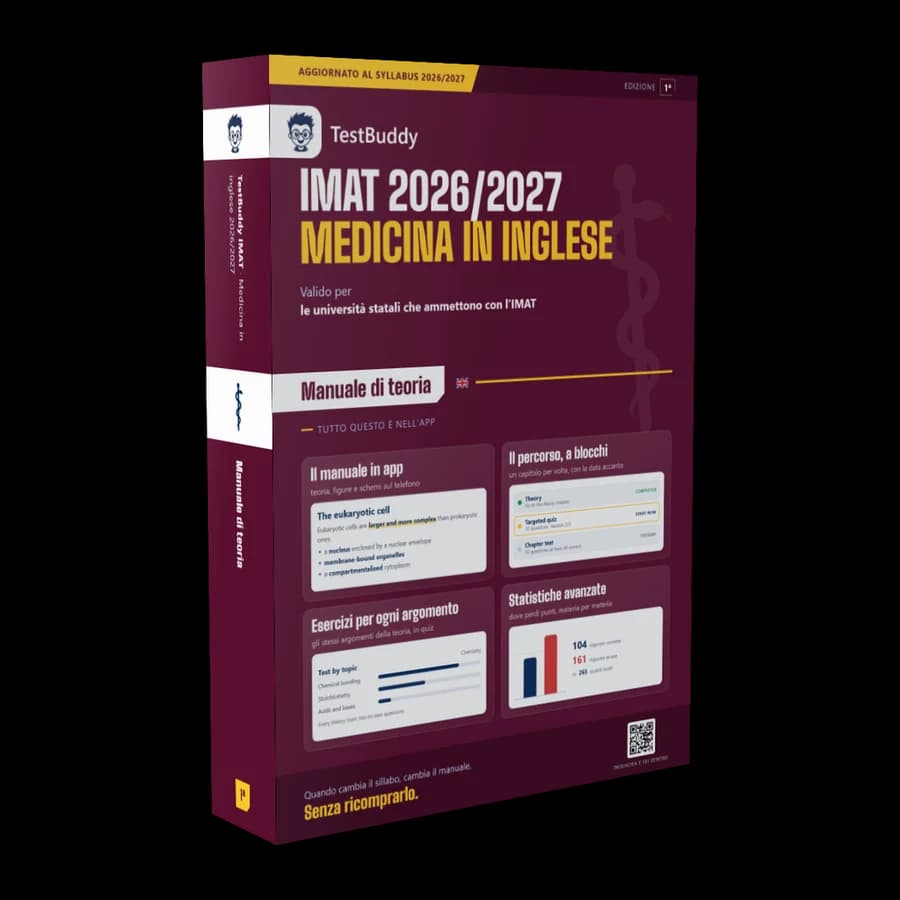
📘 Il manuale TestBuddy
Il manuale di teoria per IMAT (Medicina inglese)
Tutta la teoria, capitolo per capitolo, già dentro l'app: la studi da telefono e da computer, ed è inclusa nell'abbonamento.
- Tutte le materie del programma, spiegate in modo chiaro
- Quiz collegati a ogni capitolo, per mettere subito in pratica
- Si aggiorna quando cambia il programma, senza ricomprare niente
Guide utili per iniziare
Tutto quello che ti serve sapere per prepararti al meglio


Scritto e verificato da
Redazione TestBuddy
Un team di docenti, tutor e professionisti specializzati nella preparazione ai test di ammissione universitari e concorsi pubblici. Ogni guida viene redatta, revisionata e aggiornata per offrirti informazioni accurate e affidabili.